Wilkinson Microwave Anisotropy Probe (WMAP)
230 likes | 437 Views
Wilkinson Microwave Anisotropy Probe (WMAP). By Susan Creager April 20, 2006. Two theoretical principles of the Big Bang. General Relativity The Cosmological Principal. General Relativity.


Wilkinson Microwave Anisotropy Probe (WMAP)
E N D
Presentation Transcript
Wilkinson Microwave Anisotropy Probe (WMAP) By Susan Creager April 20, 2006
Two theoretical principles of the Big Bang • General Relativity • The Cosmological Principal
General Relativity • Gravity is not a field, but a distortion of space and time. This applies to bodies at motion as well as at rest. Its speed is the speed of light.
The Cosmological Principle • Matter is distributed evenly when averaged over large areas.
Observational Tests of the Big Bang • Expansion of the Universe • Abundance of the light elements H, He, Li • The Cosmic Microwave Background Radiation
Cosmic Background Radiation – the radiant heat left over from the Big Bang. It formed a few thousand years after the Big Bang before stars and galaxies.
Visible Stars • 10-100 years ago
Andromeda Galaxy • 2.5 million years ago
Hubble Telescope • A few billion years ago
What is in the universe? • Radiation – massless or nearly massless particles that travel at the speed of light. These include photons and neutrinos. • Baryonic matter – protons, neutrons, and electrons • Dark matter – not observed, but suspected • Dark energy – the only form of matter that can cause the universe to speed up
Wilkinson Microwave Anisotropy Probe (WMAP) 3.8 x 5 meters 840 Kg Its purpose is to map the temperature fluctuations of the CMBR.
WMAP – launched in June 2001 Launched in 2001, it was originally meant to be a 27 month mission. NASA later extended its time frame.
Original Logo – Wilkinson was added preceding MAP to honor Dr. David Wilkinson, a member of the team and a pioneer in cosmic background radiation.
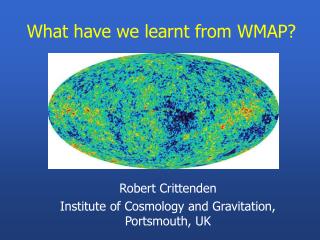
Anisotropy • Fluctuations in cosmic background radiation. CMBR is very cold – only 2.725 degrees above absolute zero. • Fluctuations may range very slightly from 2.7251 and 2.7249 degrees in one portion of the sky.
Red areas are warmer • Blue areas are cooler • White lines show “polarization” direction of old light
Early cosmic background radiationMaterial is gravitationally pulling togetherStars are formingGalaxies are formingThe present sky
References • http://map.gsfc.nasa.gov/ • http://en.wikipedia.org/wiki/Wilkinson_Microwave_Anisotropy_Probe • http://www.daviddarling.info/encyclopedia/M/Microwave_Anisotropy_Probe.html