Powerpoint Templates
This presentation covers the evaluation studies of implementing big gun sprinkler technology in Akar-akar, West Nusa Tenggara, focusing on its impact on community empowerment, institutional models, and water efficiency. The findings, lessons learned, and conclusions are discussed based on the evaluation scores from various stakeholders involved in the project. The presentation sheds light on the challenges and opportunities of adopting modern irrigation techniques in dry land typologies with limited water resources. (Words: 93)

Powerpoint Templates
E N D
Presentation Transcript
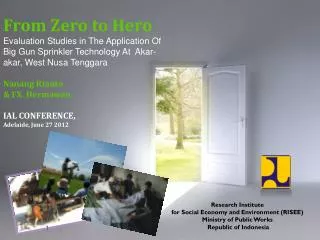
From Zero to Hero • Evaluation Studies in The Application Of Big Gun Sprinkler Technology At Akar-akar, West Nusa Tenggara • NanangRianto • & FX. Hermawan • IAL CONFERENCE, • Adelaide, June 27 2012 Research Institute for Social Economy and Environment (RISEE) Ministry of Public Works Republic of Indonesia Powerpoint Templates
REPUBLIC OF INDONESIA AKAR-AKAR VILLAGE WEST LOMBOK REGENCY WEST NUSA TENGGARA PROVINCE INTRODUCTION
Approximately 2,5 hour driving from Lombok • Dry land typology (sandy) • Land ownership (<0,5 Ha) • Seasonal harvesting • Average rainy day: 10,75 day/year • Rainfall : 147,72 mm/year • Pre-presporous family: ± 71% • Vulnerable to malnutrition • lack of community active involvement- about innactive 29 institution in the area • Groundwater pump – 90 pumps (Irrigation Directorat, 2008) • Inefficient water use for irrigation - 49,8 % more wasteful than big gun sprinkler irrigation (Dadang et al, 2010 INTRODUCTION (2)
Big gun sprinkler implementation & Community empowerment in 2006-2008 • Monitoring and evaluation 2009-present day INTRODUCTION (3)
Question Objectives
Theory (Dale, 2004: Evaluating Development Programmes and Projects)
Focus of Evaluation No Yes • Strengthening Institutional Models on Big Gun Sprinkler Technology Applications in Akar-akar
Evaluation score (Member & administrator score)