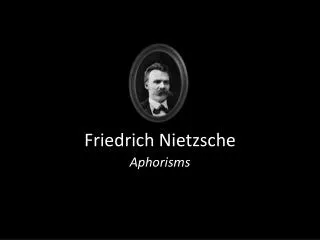
Nietzsche
Nietzsche. Who was Nietzsche?. Prodigy Schopenhauer University of Basil Academic outcast Mental Illness. After his death. Sister takes control Nazism Modern influence. Reading Nietzsche. Difficult to read some work Playful and ambiguous


Nietzsche
E N D
Presentation Transcript
Who was Nietzsche? • Prodigy • Schopenhauer • University of Basil • Academic outcast • Mental Illness
After his death • Sister takes control • Nazism • Modern influence
Reading Nietzsche • Difficult to read some work • Playful and ambiguous • Various interpretations (Kaufman, Connolly, Foucault) • Somewhat like an acquired skill
Essential Nietzsche readings • Birth of Tragedy • Thus Spoke Zarathustra • Genealogy of Morals • Nietzsche wrote far more than these, but these three writings represent three phases of his work and key points of his philosophy
Important concepts in Nietzsche • Master Morality Vs. Slave Morality • Dionysian vs. Appolonian • Nihilism • Blonde Beast • Will to Power “God is Dead”
Master Morality Vs. Slave Morality • Geneology of morals • Master morality • Slave morality • Judaism
Dionysian vs. Appolonian • Birth of Tragedy • Dionysian • Appolonian • Art and music • uninhibited life
Nihilism • What most people think of when they think of Nietzsche • There is not objective value or meaning • Symptom of the modern world • Dissolution of Christianity
Blonde Beast • Previously represented the lion • Represents the powerful • Can’t shun the beast for taking what he wants and exercising his superiority • Highly controversial, often used when discussing Nietzsche’s relation to Nazism
Will to Power • Common drive for people • We want to obtain our highest possible station in this world • That’s okay • Natural instinct
Nietzsche in debate • Nietzsche did not focus on the world beyond the mesosphere • Not necessarily one way to run Nietzsche, so we will focus on the file you have been given • Inability to accept the world as it is • If you don’t accept all of life, good and bad, you reject it, erase it’s value • Affirm life (Dionysian)
Common arguments made against Nietzsche • permutation • Nazism • Nietzsche glorifies violence, racism, genocide • Anti-politics (Wolin)