Java Data Types: A Comprehensive Overview
Explore the role of types in Java programming, covering primitive, boolean, numeric, and reference types. Learn how Java handles type conversions and casting for optimal code execution.

Java Data Types: A Comprehensive Overview
E N D
Presentation Transcript
Data Types in Java Java’s Central Casting CS 102-02 Lecture 3-1
Are You Java’s Type? • Type: a set of values that are semantically similar • Java is a strongly typed language • Every variable and every expression has a type that is known at compile time. • Strong typing helps detect errors at compile time.
What’s the Role of Types? • Types limit the: • Values that a variable can hold or that an expression can produce • Limit the operations supported on those values • Determine the meaning of the operations.
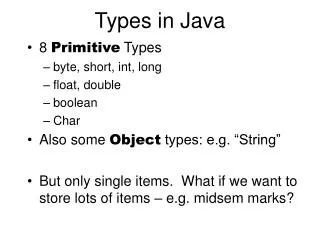
Java Types • Primitive types • boolean • numeric • Integral: byte, short, int, long, and char • Floating-point: float and double • Variables of primitive types hold the actual value
Inside a Primitive Type • Actual values for integral types: byte: -128 to 127 short: -32768 to 32767 int: -2147483648 to 2147483647 long: -9223372036854775808 to 9223372036854775807 char: from '\u0000' to '\uffff’ (from 0 to 65535) • Why use int instead of long?
Boolean Type • boolean type represents a logical quantity with two possible values, indicated by the literals true and false
Building a Boolean from a Number • Can’t say (why not?): if (x) System.out.println(“Congratulations, it’s a Boole!”); • Convert an integer x (following the C language convention that any nonzero value is true): if (x != 0) System.out.println(“Congratulations, it’s a Boole!”);
Building a Boolean from an Object • Object reference obj can be converted (any reference other than null is true): obj! = null
The Other Kind of Type • Reference types • Variables of reference types don’t hold values, but references to values • Classes, interfaces and arrays are all reference types
A Graphical View 0010010 int counter Airport midway 1110010 The data of the midway object
Classes, Interfaces and Arrays, oh my! • Classes we’ve already seen • Interfaces are programming contracts • An interface is a set of constants and methods • In Java, a class implements an interface
Implementing an Interface • An example from the Comparison applet: public class Comparison extends Applet implements ActionListener • Comparison promises to do everything an ActionListener does
Comparison Does What It Has To • What does an ActionListener have to do? actionPerformed public abstract void actionPerformed(ActionEvent e) • Provides an implementation for the interface: public void actionPerformed(ActionEvent e) { number1 = Integer.parseInt(input1.getText() ); number2 = Integer.parseInt(input2.getText() ); repaint(); }
Comparison Object has Two Types • Comparison is a class that implements an interface: public class Comparison extends Applet implements ActionListener
Interface Type Example • From the Comparison applet: input2 = new TextField( 10 ); input2.addActionListener( this ); add( input2 ); // put input2 on applet • What is addActionListener()? public synchronized void addActionListener(ActionListenerl)
Sideline Events • Events are things that happen to programs (other than errors) // Process user's action on the input2 // text field public void actionPerformed(ActionEvent e) { number1 = Integer.parseInt( input1.getText() ); number2 = Integer.parseInt( input2.getText() ); repaint(); }
Classes & Interfaces • Class type T can hold: • Null reference • Reference to an instance of class T or of any class that is a subclass of T. • Interface type can hold: • Null reference • Reference to any instance of any class that implements the interface.
Array Types • If T is a primitive type, then a variable of type "array of T"can hold: • Null reference • Reference to any array of type "array of T" • If T is a reference type, then a variable of type "array of T" can hold: • Null reference • Reference to any array of type "array of S" such that type S is assignable to type T
Object is the Root of All Java • Variable of type Object can hold: • Null reference • Reference to any object, whether class instance or array.
Class Type • Variables have types • Objects (and arrays) don’t have a type, but belong to a class • Usually we’ll consider them the same
Casting Against Type • A value could be two different types • Is 12 an int or a float? • Compiler isn’t smart, so it’s conservative (signals an error) • Override the compiler with a cast • Cast says: Treat this variable as the type I say • To cast in Java, write: (newType) variable
Examples of casting // Casting a float literal to a type int. // Without the cast operator, this would be a // compile-time error, because it’s a narrowing // conversion: int i = (int)12.5f; // From class average applet (Figure 2.9) if ( counter != 0 ) { average = (double) total / counter; System.out.println( "Class average is " + average ); } else ...
Can’t Always Cast • Can’t do this: if ((boolean) x) System.out.println(“Congratulations, it’s a Boole!”); • Sometimes casts are automatic, and are called conversions
One of Two Ways • Create an expression in a context where the type of the expression is not appropriate and either: • Error at compile time (if statement has any type other than boolean) • May be able to accept a type that is related to the type of the expression
Automatic Conversion • For convenience, Java performs an implicit conversion • From the type of the expression to a type acceptable for its surrounding context • Kinds of conversions: • Identity, Widening primitive, Narrowing primitive, Widening reference, Narrowing reference, String
Funky Conversions • What does this print? class Test { public static void main(String[] args) { int big = 1234567890; float approx = big; System.out.println(big -(int)approx); } }
Coming Attractions • Arrays: Grouping related values together • Back to objects for a bit