Understanding Electric Charge: Principles and Applications
This lecture delves into the fundamental concepts of electric charge, including how objects can be electrically neutral or charged. Demonstrations illustrate the behavior of charged rods and the attraction/repulsion between charges. Key definitions related to positive and negative charge, and the role of elementary particles such as electrons and protons are discussed. The relationship between electric charge, magnetic fields, and the principles of electrostatics are explored, alongside practical applications in technologies such as MRI, highlighting the importance of understanding these concepts in physics.

Understanding Electric Charge: Principles and Applications
E N D
Presentation Transcript
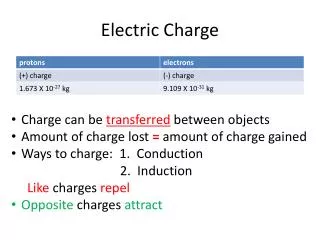
Charge (2) • Normally objects around us do not seem to carry a net charge. • They have equal amounts of positive and negative charge and are thus electrically neutral. • Demo: • If we rub a plastic rod with fur, the rod will become charged • If we bring two charged plastic rods together, they will repel each other • If we rub a glass rod with silk, the rod will become charged • If we bring together a charged plastic rod and a charged glass rod, they will attract each other • Negative charge: an excess of electrons • Positive charge: a deficit of electrons 184 Lecture 2
“Ley de las cargas” - - - + + + m1 m2 • Cargas del mismo signo se repelen y de signo opuesto se atraen • Nótese que la electricidad es algo diferente de la gravitación …. 184 Lecture 2
Electrostatica +q - - - 0 - + - Polarización! + + + + • Cual es la fuerza entre un objeto eléctricamente cargado (q) y un objeto neutro (0)? • Nótese que siempre es atractiva !! • Por qué? 184 Lecture 2
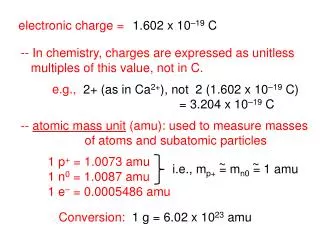
Carga del Electrón • Se puede definir la unidad de carga en terminos de la carga de un electrón**… • Un electrón es una partícula elemental con carga q = -e, donde • e = 1.60210-19 C • Un protón es una partícula ‘elemental’ con q = +e e = 1.602 x 10⁻¹⁹ C ** El ampere (André-Marie Ampère (1775 - 1836)]. es la 4ta unidad básica en el SI como el metro, el segundo y el kilogramo 184 Lecture 2
Coulomb of Charge • A full coulomb is a very large amount of charge! • A lightning discharge can contain 10’s of coulombs • Demo - Wimshurst machine • The number of electrons required to produce 1 coulomb of charge is • Because a coulomb is a large amount of charge, everyday examples of static electricity typically involve • 1 microcoulomb = 1 C = 10-6 C • 1 nanocoulomb = 1 nC = 10-9 C • 1 picocoulomb = 1 pC = 10-12 C 184 Lecture 2
El quantum de carga • La carga electrica esta’ cuantizada • La carga mas pequenha observable es la del electron • Robert Millikan (1868 - 1953) y el experimento de la gota de aceite Carga del electron = -e = 1.60210-19 C 184 Lecture 2
La estructura atómica • Sistema planetario infinitesimal??! • Electricamente neutro: electrones ‘orbitando’ alrededor de un nucleo ‘en reposo’ • Ejemplo: 12C tiene 6 protones, 6 neutrones and 6 electrones • Isotopos 184 Lecture 2
Magnetic Resonance Imaging - MRI Magnetic Field = 1.5 T Magnetic Field = 3.0 T • MRI stands for nuclear magnetic resonance imaging. • MRI produces high quality images of living tissue without causing any damage. • The quality of an MRI image (signal-to-noise) is proportional to the the magnitude of the magnetic field • High field mean high quality images • Superconducting magnets can produce up to four times the magnetic field of a room-temperature magnet. Yue Cao, Stephen Whalen, Jie Huang, Kevin L. Berger, and Mark C. DeLano, Human Brain Mapping 20:82–90(2003). (MSU Radiology) 184 Lecture 2
Dielectricos, Semiconductores, Conductores, Superconductores Chip con millones de transistors Replica del 1er transistor en 1947 • Dielectricos = aislantes, no conducen o conducen muy mal la electricidad • En el conductor los electrones se mueven como si fuesen un fluido • Semiconductores tienen un comportamiento electrico como aislante y conductor • Superconductividad: solo a muy bajas temperaturas 184 Lecture 2
Ley de Coulomb • Fuerza eléctrica entre cargas puntuales… • dependencia 1/r2 como en gravitación • K constante de Coulomb 0 permitividad del vacío 184 Lecture 2
The Electric Field Field Theory The electric force is not “action at a distance” but is the action of a field. A field is a physical entity that extends throughout a volume of space and exerts forces. Electric field = E(x,t) Magnetic field = B(x,t) 184 Lecture 2
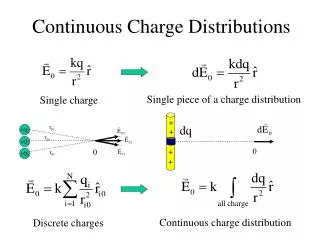
Campo Eléctrico + + Test charge q • Una carga crea o genera un campo alrededor de ella y otras cargas sienten ese campo Carga de prueba: carga puntual positiva muy pequenha tal que no modifica el campo original 184 Lecture 2
Algunas propiedades de las lineas de campo Weak Strong • La intensidad del campo eléctrico está representada por la densidad de líneas • La dirección del campo eléctrico es tangente a las líneas de campo 184 Lecture 2
Lineas de campo: carga puntual 3D 2D 184 Lecture 2