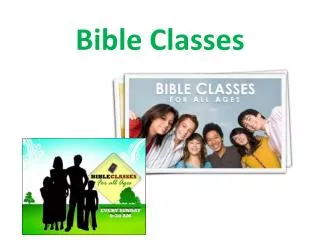
Reassessing Bible Classes: Their Role in Christian Assembly and Community Growth
Have you ever considered the typical Bible class setup in many churches? Are these classes part of the true assembly, or are they something else entirely? This reflection explores the organization and purpose of Bible classes, emphasizing their role as an expedient for growth rather than a substitute for assembly. We delve into the idea that these classes should not promote personal agendas but instead foster kindness, detail study, and unity among participants. Understanding this can help reflect on how Bible classes can positively contribute to our spiritual community.

Reassessing Bible Classes: Their Role in Christian Assembly and Community Growth
E N D
Presentation Transcript
Have you ever given serious thought to the typical Bible class arrangement seen in most churches of Christ (not talking about “Sunday School”)? Do such classes constitute the “assembly” and if not, how should they be considered? Reflections on Bible Classes
Reflections on Bible Classes Some have practiced the class circumstance (various classes according to age, gender, etc.) and in this situation, have served the Lord’s Supper (cp. I Cor. 11: 18, 20, 23-34).
Reflections on Bible Classes It is apparent that some circumstances that are viewed as having all physically together were not such (cp. Acts 2: 46). Bible classes serve as an expedient (cp. I Tim. 3: 15 but not a substitute for “the assembly”).
Not a free-for-all think tank. Reflections on Bible Classes
Not for the promotion of personal agendas. Reflections on Bible Classes
Not for doing what cannot be done in the assembly. Reflections on Bible Classes
Must be organized. Reflections on Bible Classes
Kindness and regard must prevail. Reflections on Bible Classes
Opportunity for detail study…. Reflections on Bible Classes
As an expedient, Bible classes must promote good, growth, and unity as opposed to ill feeling, infantilism, and disunity. Reflections on Bible Classes