Download
1 / 8
80 likes | 282 Views
Solid-state power devices are essential in modern electronic applications, featuring different voltage and current ratings suitable for various uses. Key types include Bipolar Junction Transistors (BJT), Insulated Gate Bipolar Transistors (IGBT), MOSFETs, and thyristors, each with unique properties such as voltage rating, current capacity, and switching speed. Key factors include off-state blocking voltage, on-state voltage losses, and power dissipation limits. Understanding these characteristics is crucial for optimizing performance and preventing damage in electrical systems.

E N D
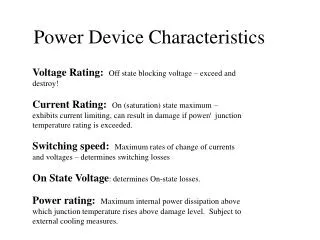
Voltage Rating: Off state blocking voltage – exceed and destroy! Current Rating: On (saturation) state maximum – exhibits current limiting, can result in damage if power/ junction temperature rating is exceeded. Switching speed: Maximum rates of change of currents and voltages – determines switching losses On State Voltage: determines On-state losses. Power rating: Maximum internal power dissipation above which junction temperature rises above damage level. Subject to external cooling measures. Power Device Characteristics
Solid State Power Devices • Bipolar Junction Transistors (BJT) • Insulated Gate Bipolar Transistor (IGBT) • Metal Oxide-Semiconductor Field Effect Transistor (MOSFET) • Thyristors (SCR, TRIAC) • Integrated-Gate-Controlled Thyristors (IGCT) • Gate Turn-Off Thyristors (GTO) • MOS Controlled Thyristors (MCT) • MOSFET – • High frequency ( > 100 khz) • “Low” Voltage ( < 300 v) • IGBT – • Very High Power (DC applications ~ Megawatts) • Low Frequency ( < 50 kHz) • Thyristors – • (Utility applications 1-2 Megawatts)
MOSFET D ID ID + VDS G - + VGS - S VGS(th) VGS
MOSFET Features Voltage Rating : < 200 v Cannot tolerate reverse voltages Current Rating: Up to 200 A, can operate multiple devices in Parallel Low On-state Resistance when properly cooled High switching speeds >100 kHz Low energy drive requirements
IGBT G C IC IC + VCE + - VGE VGE - E VCE
IGBT Features Voltage Rating : Up to 3 Kv Can tolerate moderate reverse voltages Current Rating: Up to 1200 A, can operate multiple devices in Parallel Low On-state Losses Switching speeds up to 30 kHz Low energy drive requirements
Integrated Power Modules (IPM) Combine multiple power devices, drive circuitry, fault protection and heat sink into single module. Single and multi phase motor drives.
Power Diodes High Forward Currents – up to 5 kA High Blocking (Reverse)Voltages – up to 9 kV IF • Line Frequency Diodes (60 Hz – 9 kV, 5 kA) • Fast Recovery Diodes (Rapid Turn-on) • Schottky Diodes (Low Forward/On voltage) • Silicon Carbide/SiC (High Voltage, High speed, High Temp) IR VBD VF