The Pythagorean Theorem
This lesson aims to teach and apply the Pythagorean Theorem, a fundamental concept in mathematics involving the relationship between the sides of a right triangle. The theorem states that in a right triangle, the square of the hypotenuse (c) is equal to the sum of the squares of the other two sides (a and b). Through sample problems, students will learn to calculate the hypotenuse and the lengths of the sides of right triangles. Additionally, practical applications are presented, such as using a ladder against a building or measuring distances in sports.

The Pythagorean Theorem
E N D
Presentation Transcript
Objectives • The objective of this lesson is for you to learn and apply the Pythagorean Theorem -- an important relationship between the three sides of a right triangle.
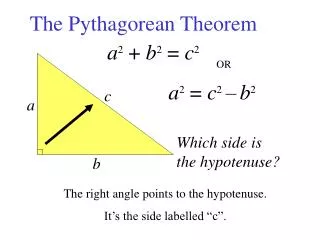
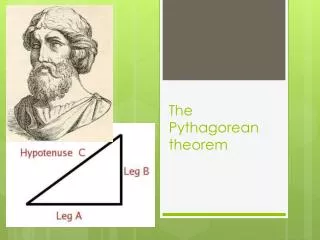
The Theorem • One of the most important and fundamental theorems in all of mathematics • Where a and b are the two legs of the right triangle and c is the hypotenuse.
Sample Problem • If the two legs of a right triangle measure 3 and 6, then what is the length of the hypotenuse?
Basic Problems • If the two legs of a right triangle measure 5 and 12, then what is the length of the hypotenuse? • If the hypotenuse of a right triangle measures 10 and one leg measures 5, then what is the length of the other leg?
Problems • Find out the length of sides a and b on the following triangle:
Problems • What is the longest straight pole, like the red one, that you can have inside the box?
Application Problems • There is a building with a 12 ft high window. You want to use a ladder to go up to the window, and you decide to keep the ladder 5 ft away from the building to have a good slant. How long should the ladder be? • On a baseball diamond the bases are 90 ft apart. What is the distance from home plate to second base in a straight line?
Pythagorean Triples • Pythagorean Triples are sets of three integer values that satisfy the Pythagorean Theorem • Common Triples ( 3, 4, 5) ( 5, 12, 13) ( 7, 24, 25) ( 8, 15, 17) ( 9, 40, 41) (11, 60, 61) (12, 35, 37) (13, 84, 85) (16,63, 65) (20, 21, 29) (28, 45, 53) (33, 56, 65) (36, 77, 85) (39, 80, 89) (48, 55, 73) (65, 72, 97)