Loss of Heterozygosity Not Observed in BRCA2 Mutation Carriers with High-Grade PIN
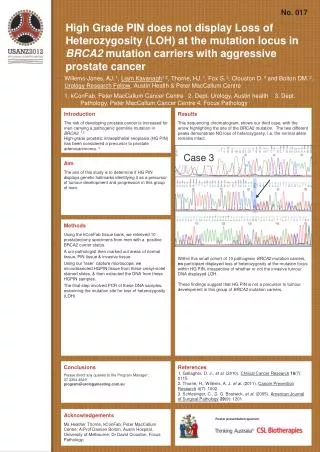
This study investigates whether high-grade prostatic intraepithelial neoplasia (HG-PIN) displays loss of heterozygosity (LOH) at the BRCA2 mutation locus in carriers with aggressive prostate cancer. Despite the known risk associated with BRCA2 mutations, our cohort of 10 carriers did not exhibit LOH at the mutation site within HG-PIN tissues, suggesting that HG-PIN may not serve as a precursor to invasive tumor development in this population. This finding challenges existing assumptions about the role of HG-PIN in prostate cancer progression among BRCA2 mutation carriers.

Loss of Heterozygosity Not Observed in BRCA2 Mutation Carriers with High-Grade PIN
E N D
Presentation Transcript
Case 3 No. 017 High Grade PIN does not display Loss of Heterozygosity (LOH) at the mutation locus in BRCA2 mutation carriers with aggressive prostate cancer Willems-Jones, AJ. 1, Liam Kavanagh1,2, Thorne, HJ. 1, Fox S. 3, Clouston D. 4 and Bolton DM. 2. Urology Research Fellow, Austin Health & Peter MacCallum Centre 1. kConFab, Peter MacCallum Cancer Centre 2. Dept. Urology, Austin health 3. Dept. Pathology, Peter MacCallum Cancer Centre 4. Focus Pathology Introduction The risk of developing prostate cancer is increased for men carrying a pathogenic germline mutation in BRCA2. 1,2 High-grade prostatic intraepithelial neoplasia (HG PIN) has been considered a precursor to prostate adenocarcinoma. 3 Results This sequencing chromatogram, shows our third case, with the arrow highlighting the site of the BRCA2 mutation. The two different peaks demonstrate NO loss of heterozygosity, i.e. the normal allele remains intact. Within this small cohort of 10 pathogenic BRCA2 mutation carriers, no participant displayed loss of heterozygosity at the mutation locus within HG PIN, irrespective of whether or not the invasive tumour DNA displayed LOH. These findings suggest that HG PIN is not a precursor to tumour development in this group of BRCA2 mutation carriers. Aim The aim of this study is to determine if HG PIN displays genetic hallmarks identifying it as a precursor of tumour development and progression in this group of men. Methods Using the kConFab tissue bank, we retrieved 10 prostatectomy specimens from men with a positive BRCA2 carrier status. A uro-pathologist then marked out areas of normal tissue, PIN tissue & invasive tissue. Using our ‘laser’ capture microscope, we microdissected HGPIN tissue from these cresyl-violet stained slides, & then extracted the DNA from these HGPIN samples. The final step involved PCR of these DNA samples, examining the mutation site for loss of heterozygosity (LOH). Conclusions Please direct any queries to the Program Manager: 07 3354 4629program@urologymeeting.com.au References 1. Gallagher, D. J., et al. (2010). Clinical Cancer Research16(7): 2115. 2. Thorne, H., Willems, A. J. et al. (2011). Cancer Prevention Research 4(7): 1002. 3. Schlesinger, C., D. G. Bostwick, et al. (2005). American Journal of Surgical Pathology29(9): 1201. . Acknowledgements Ms Heather Thorne, kConFab, Peter MacCallum Centre; A/Prof Damien Bolton, Austin Hospital, University of Melbourne; Dr David Clouston, Focus Pathology; Poster presentation sponsor