Understanding B Cell Development and Class Switching Mechanisms
This announcement outlines key concepts in B cell differentiation and development, focusing on case studies 10 and 12, while providing background relevant to case study 11. Emphasis is on class switching in B cells, the roles of AID, UNG, and APE1 in DNA rearrangement, and the influence of stromal cells. This resource covers cellular adhesion, cytokine signaling, and the mechanics of light and heavy chain rearrangement essential for successful B cell maturation. Aimed for study before exams on February 15 and 20, 2008, this information is crucial for understanding immune responses.

Understanding B Cell Development and Class Switching Mechanisms
E N D
Presentation Transcript
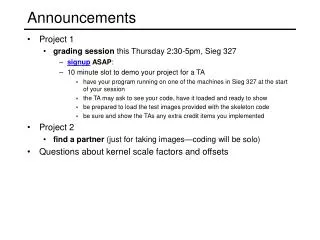
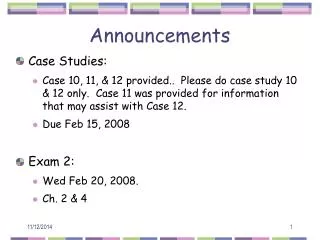
Announcements • Case Studies: • Case 10, 11, & 12 provided.. Please do case study 10 & 12 only. Case 11 was provided for information that may assist with Case 12. • Due Feb 15, 2008 • Exam 2: • Wed Feb 20, 2008. • Ch. 2 & 4
Class Switching occurs as the B cells are stimulated by Ag. Differentiation into Plasma Cells.
Can rearrangement be nonproductive? • If we have a switch from mu to alpha1, can we have revert back to the mu?
Mechanism for class switching not completely understood! • AID, UNG, & APE1 participate by making single strand nicks in DNA.
B cell Development Chapter 4
Foreign Antigen Independent Foreign Ag Dependent
Proliferates to produce 32-64 progeny Late Pro-B cell Naïve B cell
B cell Development is dependent upon: • Stromal Cells: • Make specific cell surface contacts with developing B cells. • Adhesion molecules & ligands. • Secrete cytokines & growth factors. • Productive Rearrangement of the L & H chain gene segments.
Cell to Cell contact is mediated by CAMs- Cell Adhesion Molecules: • VLA-4: on stem cells. • Binds VCAM-1 on stromal cells • Kit: binds to SCF & has tyrosine kinase activity. • Signals proliferation • Up-regulation of IL7R • Stem Cell Factor (SCF)- membrane bound cytokine on stromal cells.
Kit functions as a tyrosine kinase & mediates signal transduction IL-7 downregulates expression of kit & induces development.
Endosteum- inner bone surface Pro B cells detected- TdT Center of BM
B cell development is dependant upon Productive Rearrangement of the L & H gene segments: 1/2 successful ~ ½ nonproductive
Light chain Rescue: • The L chain gene region can have more than 1 attempt at a single locus.
Only 1 H chain allele & 1 L chain allele is expressed! • G.D. Yancopoulis & R.W. Alt- Model for allelic exclusion: • Once a productive rearrangement is obtained, its encoded protein is expressed & this proteins presence acts as a signal to prevent further gene rearrangement.
Primary check point. • Is RAG being produced in the late pre B cell?