Download
1 / 2
30 likes | 153 Views
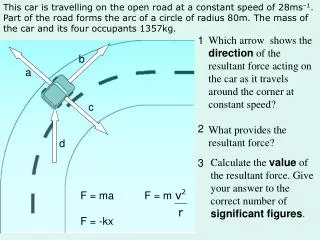
This problem examines a car traveling along an arc of a circle with a radius of 80 m at a constant speed of 28 m/s. We explore the direction of the resultant force acting on the car as it navigates the curve and identify the source of this force. Additionally, we calculate the value of the resultant force using the mass of the car and its occupants (1357 kg). The solution involves applying Newton's Second Law and understanding the role of friction as the centripetal force keeping the car on its circular trajectory.

E N D
This car is travelling on the open road at a constant speed of 28ms–1. Part of the road forms the arc of a circle of radius 80m. The mass of the car and its four occupants 1357kg. 1 Which arrow shows the direction of the resultant force acting on the car as it travels around the corner at constant speed? What provides the resultant force? 2 Calculate the value of the resultant force. Give your answer to the correct number of significant figures. 3 F = ma F = m F = -kx b a c d
This car is travelling on the open road at a constant speed of 28ms–1. Part of the road forms the arc of a circle of radius 82m. The mass of the car and its four occupants 1357kg. C Friction between the tyres and the road. F = m b a c d F = 1375 x F = 12974 F= 13000 N (2 sig fig) F = ma F = m F = -kx