
Understanding Selection Sort Algorithm: A Comprehensive Guide
E N D
Presentation Transcript
Selection sort Presentation Yixin Wang
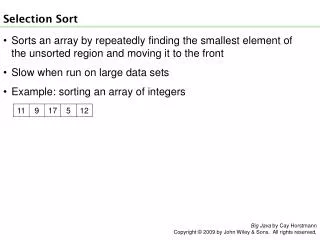
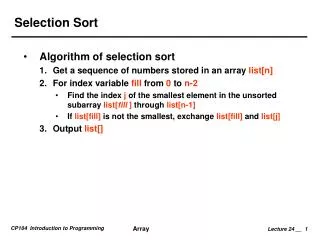
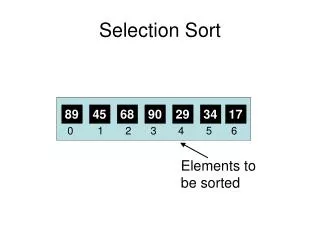
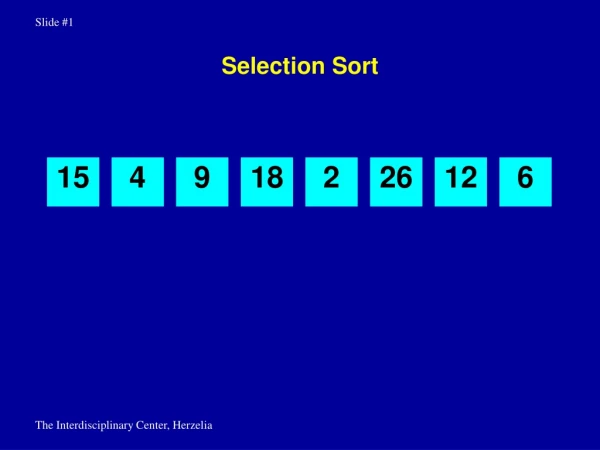
The Algorithm The big structure of selection sort is looping In each loop, usually we should do two steps. • Find the smallest or biggest value in the list. • Interchange the smallest or biggest value with the first or last element. Than, loop thought the remaining list and do the same thing.
Examples • 61, 5 , 91, 60,45 • 5, 61, 91, 60, 45 • 5, 45, 91, 60, 61 • 5, 45 ,60, 91, 61 • 5, 45 ,60 ,61 ,91
Another example • 17, 26, 9,50, 76 • 17, 26, 9 ,50 ,76 • 17, 26 ,9, 50, 76 • 17,9 ,26 ,50 ,76 • 9, 17, 26, 50 ,76 • The first two steps don’t make any change but it still loop thought the remaining list.
Time complexity • If the number of element in the list is n, then we should loop n-1 times to finish sort all the elements in the list. • From the example we can see that even if the list is already sorted, system still have to loop and do comparison. • So the best case like list : 1 2 3 4 5 …….n-1, n In first loop, it has to do n-1 times comparison. In the second loop n-2 times , third loop n-3. so, the total time complexity is (n-1)+(n-2)+(n-3)+……….+3+2+1 which is equal to (n+(n-1)+(n-2)+……+2+1)-1 =n*(n+1)/2 -1 Apparently, the interchange complexity and of this best case is 0
Time complexity cont.…. • The “ worst case” : n, n-1,n-2, ……..3,2,1 The time complexity of the comparison is still n*(n+1)/2 -1 But for interchange time complexity is different. If n is odd, then it has to interchange (n-1)/2 times, if n is even, it has to change n/2 times. The worst case for change complexity : n,1,2,3,4,……n-2,n-1 Time complexity for comparison is n*(n+1)/2 -1 Time complexity for interchange complexity is n-1.(every loop need to change one time)
Summary for time complexity • Time complexity for comparison is always n*(n+1)/2 -1 Time complexity for interchange depends. for best case is 0, average is If n is odd, (n-1)/2 times, if n is even, it has to change n/2 times. for worst case is n-1.
Extra memory • As we know, each interchange procedure needs one extra memory. So for best case: 1,2,3,……n-1,n needs no extra memory.(no interchange procedure) Worst case : n, 1,2,……n-2,n-1, needs n-1 slot of memory.(n-1 times interchange procedure)
According to the algorithm, data structures selection sort can use are arrays, binary trees, and every kinds of lists. • Stack and queue can not use this algorithm, because these two structures can bot interchange with two element directly.