Parallel Computing Techniques and Applications in Scientific Computing
This lecture covers various aspects of parallel computing, focusing on MPI, OpenMP, and numerical methods. It includes a demo of the Mandelbrot set using MPI and a mini-course on synchronous computations. Participants will explore techniques through case studies, including a discussion on numerical methods for singular perturbations. Additionally, lessons on HPC Clouds using Amazon EC2 will be highlighted, along with examples of implementing numerical methods in Python. This session is relevant for researchers and students interested in computational techniques in scientific applications.

Parallel Computing Techniques and Applications in Scientific Computing
E N D
Presentation Transcript
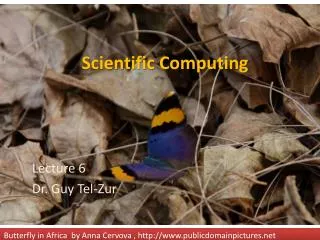
Scientific Computing Lecture 6 Dr. Guy Tel-Zur Butterfly in Africa by Anna Cervova , http://www.publicdomainpictures.net
Agenda • MPI demo Mandelbrot set (again) • MPI mini-course part III: Synchronous Computationsfrom: ITCS 4/5145 Parallel computing, UNC-Charlotte, B. Wilkinson, 2009. Chapter 6 of Wikinson&Allen’s book: Parallel Programming: Techniques and Applications Using Networked Workstations and Parallel Computers
Agenda • OpenMP mini-course – SC99 OpenMPtutorial:http://www.openmp.org/presentations/sc99/sc99_tutorial.pdf • Numerical case study • FlexPDE demo (if time will permit) • HPC Clouds demo on Amazon’s EC2 (if time will permit)
Numerical Case Study • “The Capriciousness of Numerical Methods for Singular Perturbations” by Sebastian Franz and Hans-Görg Roos, SIAM Rev. 53, pp. 157-173 (17 pages), March 2011 • Available free online at: http://epubs.siam.org/sirev/resource/1/siread/v53/i1/p157_s1?bypassSSO=1 • Will discuss only the first part of section 2 in the article, up to Eq. 2.6.
wasow.py, part 1/3 # -*- coding: utf-8 -*- """ Created on Thu Mar 17 12:04:49 2011 @author: telzur """ import numpy as np from scipy.linalg import * from scitools.all import * #from scipy.linalg import toeplitz, inv N=100 h=1./N epsilon=0.0001 u=np.zeros(N) x=np.linspace(0,1,N) ni=h*h/epsilon # exact Uexact=(1.-np.exp(-x/epsilon))/(1.-np.exp(-1./epsilon))-x # central difference kplus=1.+h/(2*epsilon) kminus=1.-h/(2*epsilon) u1=np.zeros(100) u2=np.zeros(100)
u1[0]=-2. u2[0]=-2. u1[1]=kplus u2[1]=kminus W=toeplitz(u2,u1) # array type, …, -49, -2, 51,… S=inv(W) Sm=np.mat(S.copy()) # convert an array to a matrix I=np.ones(100)*(-ni) Im=np.mat(I.copy()) # convert to a matrix U=Sm*Im.transpose() # upwind scheme kplus=1.+h/epsilon u1=np.zeros(100) u2=np.zeros(100) u1[0]=-2.-h/epsilon u2[0]=-2.-h/epsilon u1[1]=kplus u2[1]=1. W=toeplitz(u2,u1) # array type, …, 1, -102, 101, … S=inv(W) Sm=np.mat(S.copy()) # convert an array to a matrix I=np.ones(100)*(-ni) Im=np.mat(I.copy()) # convert to a matrix wasow.py, part 2/3
wasow.py, part 3/3 Uupwind=Sm*Im.transpose() # visualization and output plot(x,array(U),'b',x,Uexact,'k') xlabel('x') ylabel('U') title('Central difference scheme') axis([0, 1, 0, 2]) show() hardcopy('fig1.png') figure() plot(x,array(Uupwind),'ro',x,Uexact,'k') xlabel('x') ylabel('U') title('Upwind difference scheme') axis([0, 1, 0, 1]) show() hardcopy('fig2.png') foo=raw_input('Hit any key to close') print 'done!'
Another Python IDE Tip: how to execute a script from the Python shell: execfile(“myscript.py”)
Executing the program: right click “run in interactive mode” or open the IDE and click on F5
Tips • Microsoft Mathematics
Proceed to MPI / Chapter 6 • Then, OpenMP SC99 Tutorial