Optimizing Network Protocols for Interactive Multi-user Gaming: A Case Study on Doom
This research explores the application of traditional protocols in modern gaming environments, focusing on the Doom game. Led by Austin Clements, Patrick Tullmann, and Jay Lepreau from the University of Utah's Flux Research Group, the study identifies properties of Doom's in-network processing that are exploitable to enhance scalability, reduce bandwidth, and minimize latency. The implementation showcases how techniques like application-aware servers and multicast aggregation can achieve up to a 38% reduction in sent data and a fourfold increase in update rates, ensuring a more reliable and efficient gaming experience.

Optimizing Network Protocols for Interactive Multi-user Gaming: A Case Study on Doom
E N D
Presentation Transcript
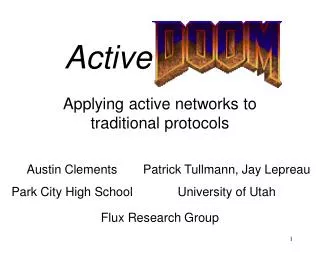
Active Applying active networks to traditional protocols Austin Clements Park City High School Patrick Tullmann, Jay Lepreau University of Utah Flux Research Group
Focus • Real application, real protocol • Identify exploitable properties • Doom-specific in-network processing
Doom • Multi-user, peer-to-peer, interactive simulation
Properties of the Protocol • Game engine requirements: totally ordered, reliable, complete update stream • Implementation: unicast • Lock-step nature • Reliability is vital • Low-latency is vital
In-network Processing • Application aware servers • In-network application-level totally ordered multicast • Aggregation • Compression
Evaluation and Conclusion • Scalability • Bandwidth • Latency Initial results • Simulation: • Factor of <# of clients> decrease in sent data • 38% less data, due to compression • Implementation: 4x increased update rate
Evaluation and Conclusion http://www.cs.utah.edu/flux/ Initial results • Simulation: • Factor of <# of clients> decrease in sent data • 38% less data, due to compression • Implementation: 4x increased update rate