Download
1 / 8
80 likes | 198 Views
This presentation explores the concept of phase difference in wave mechanics, particularly focusing on the equations dictating how different wave paths lead to variations in phase. We'll delve into the characteristics of standing waves generated by strings with different boundary conditions, explaining their wavelengths associated with fixed and free ends. Additionally, we will examine sound waves in various configurations and analyze ray optics phenomena, including ray behavior with mirrors and reflections. Join us to deepen your understanding of these fundamental physics concepts!

E N D
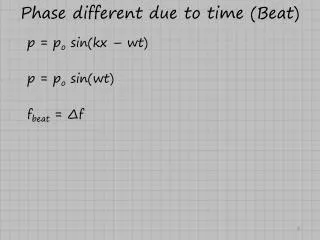
Phase different due to time (Beat) p = po sin(kx – wt) p = posin(wt) fbeat = Δf
Phase difference due to Path p = po sin(kx – wt) Φ=kx2 – kx1
Standing Wave (String) Free One End λ=4L/n Fixed Both Ends λ=2L/n
Standing Wave (sound) Open One End λ=4L/n Open Both Ends λ=2L/n
Special Rays (pick your favorite two) • Ray parallel to central axis, reflect through focal • Ray reflects from mirror after passing through focal • Ray passes through center of curvature and returns along itself • Symmetric reflection