Download
1 / 1
10 likes | 97 Views
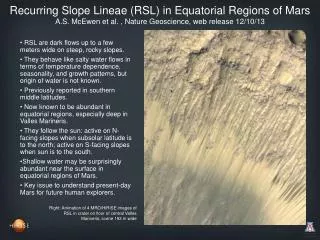
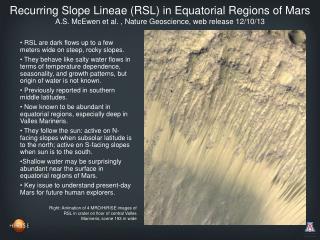
Referred to as Recurring Slope Lineae (RSL), these dark flows on Mars resemble salty water flows in behavior, despite their unknown origin. Found in equatorial regions like Valles Marineris, they exhibit temperature-dependent, seasonal, and growth patterns. By following the sun's position, these flows become active on different slopes. This phenomenon, now abundant in equatorial regions of Mars, could hold clues for future human exploration. Watch a compelling animation showing RSL in action in Valles Marineris.

E N D
RSL are dark flows up to a few meters wide on steep, rocky slopes. They behave like salty water flows in terms of temperature dependence, seasonality, and growth patterns, but origin of water is not known. Previously reported in southern middle latitudes. Now known to be abundant in equatorial regions, especially deep in Valles Marineris. They follow the sun: active on N-facing slopes when subsolar latitude is to the north; active on S-facing slopes when sun is to the south. Shallow water may be surprisingly abundant near the surface in equatorial regions of Mars. Key issue to understand present-day Mars for future human explorers. Recurring Slope Lineae (RSL) in Equatorial Regions of MarsA.S. McEwen et al. , Nature Geoscience, web release 12/10/13 Right: Animation of 4 MRO/HiRISE images of RSL in crater on floor of central Valles Marineris; scene 193 m wide


















![Best Lawn Mower For Steep Slopes [Review 2020]](https://cdn5.slideserve.com/9915592/best-lawn-mower-for-steep-slopes-dt.jpg)