Download
1 / 8
80 likes | 214 Views
2. Modern Political Parties a) Republican Party 1) single-issue 3rd party until Lincoln won (1860) 2) Civil War: Voter realignment, dominant party until 1932. 3) Northern farmers, bankers, business owners, Union soldiers, blacks 4) Today a) Power shift to states

E N D
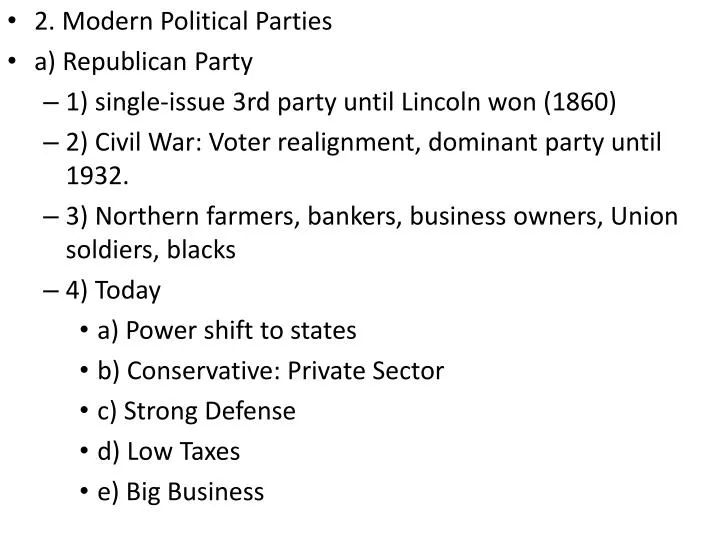
2. Modern Political Parties • a) Republican Party • 1) single-issue 3rd party until Lincoln won (1860) • 2) Civil War: Voter realignment, dominant party until 1932. • 3) Northern farmers, bankers, business owners, Union soldiers, blacks • 4) Today • a) Power shift to states • b) Conservative: Private Sector • c) Strong Defense • d) Low Taxes • e) Big Business
b) Democratic Party • 1) Solid South after Civil War • 2) Depression causes voter realignment, dominant party until 1968. • 3) New Coalition: Labor, city dwellers, blacks • 4) Today • a) Strong Central gov’t • b) Liberal: Public Sector • c) Social/Welfare Programs • d) Higher taxes to support programs • e) Labor Unions/Minorities Today parties power shifts back and forth
C. The Role of Minor (Third) Parties • 1) Types • a) Single-Issue (prohibition) or personality (Bull-Moose) • b) Ideologically Different: Usually radical (Socialist, Communist, Know Nothings) • c) Splinter groups from major Parties, usually regional (Dixiecrats, Free Soil, Am Indep.) • D) Economic goals or protests (Populists, Progressives, Green-backs, Libertarians)
2. Function/Impact • a) Safety valves: outlet for anger or dissent. • b) New Ideas: Those too controversial for major parties to take a stand on (income tax, woman’s suffrage, prohibition, child labor laws, etc) • c) Critics of Am Gov’t: watchdog. • d) Spoiler (sometimes): Bull Moose (1912)
3. Obstacles • a) Tradition • b) winner-take-all electoral system • c) election laws • d) lack of broad national appeal • e) lack of media coverage • f) ideas absorbed by major parties • g) lack of strong organization • h) lack of $ • i) too much success
Sec.2: Organization and Functions • A. Political Party Organization • 1.Both parties are broad-based in support • a. Joining is voluntary/free • b. Include people of all regions, class, religion, occupation. • 2. Both are Centrist in ideology • a. Most Americans are moderate.
3. Both are decentralized in organization • a. State and local independent national =a confederation. • b.
B. Party Functions • 1) Win elections • 2) Moderate Conflicts: put together coalitions • 3) Educate Voters: provide info and simplify issues • 4) encourage political participation • 5) provide people to run the gov’t • 6) recruit/select candidates • 7) raise $ • 8) Out of power, criticize/evaluate those in power=loyal opposition • 9) dispense patronage