Download
1 / 9
90 likes | 222 Views
This guide aims to equip you with the essential skills to model a single-stage water rocket using principles from unified thermodynamics and fluid mechanics. After completing this study, you will learn to integrate ordinary differential equations via spreadsheet tools, analyze how various parameters affect rocket performance, and develop a preliminary design for a practical water rocket launching project. Key topics include the dynamics of external aerodynamics, structural weight, propellant mass fraction, and the effects of gravity and drag during flight.

E N D
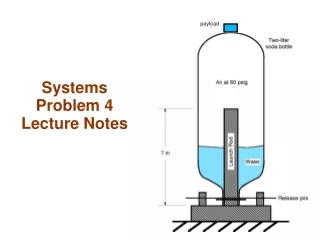
payload Systems Problem 4Lecture Notes
Learning objectives • After completing this SP4 and SP5 you will have: • Applied material from 8.01, (Unified thermodynamics) and Unified fluid mechanics to develop a model for a single stage water rocket • Demonstrated an ability to integrate a system of ordinary differential equations using a spreadsheet • Explored how external aerodynamics, structural weight, propellant mass fraction, payload mass, internal fluid mechanics and thermodynamics jointly determine the dynamic behavior of a single stage water rocket. • Demonstrated an ability to describe conceptually how the performance of the water rocket changes as a function of important design parameters • Developed a preliminary design for a water rocket that you and a partner may build and test for SP6 SP4 SP5
3 stages Stage 3 Ballistic Gravity and drag forces Stage 1 Quasi-static adiabatic expansion as rocket lifts off launch rod Constant mass Stage 2 Quasi-static adiabatic expansion Water ejected from rocket Gravity, drag, thrust forces
Open items • Initial conditions • Modeling stage 1 • Thrust (Ti)? • Exit velocity (uei)? • Integrating the equations • Analyzing the results • Developing a design + rationale
Modeling the gas expansion • Work = change in energy • Adiabatic, quasi-static • g = 1.4 for air pressure volume
Thrust from the momentum equation • Force = time rate of change of momentum