Download

1 / 0
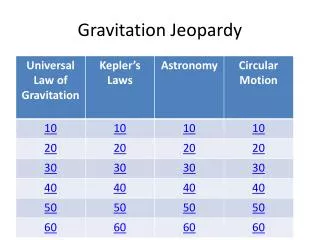
Gravitation Jeopardy
0 likes | 132 Views
Dive into the foundational concepts of gravitation with our Gravitation Jeopardy series! In Part 1, we explore Newton’s Law of Universal Gravitation, where you’ll learn how every mass attracts another with a force proportional to the product of their masses and inversely proportional to the square of their distance. Test your knowledge with engaging questions and interactive challenges that make learning about gravitational forces fun and informative. Join us to unlock the mysteries of the universe!

Download Presentation 
Gravitation Jeopardy
An Image/Link below is provided (as is) to download presentation
Download Policy: Content on the Website is provided to you AS IS for your information and personal use and may not be sold / licensed / shared on other websites without getting consent from its author.
Content is provided to you AS IS for your information and personal use only.
Download presentation by click this link.
While downloading, if for some reason you are not able to download a presentation, the publisher may have deleted the file from their server.
During download, if you can't get a presentation, the file might be deleted by the publisher.
E N D
Presentation Transcript
- Gravitation Jeopardy
-
Part 1: Universal Law of Gravitation
- 10 Points – ULG State Newton’s Law of Universal Gravitation. Answer Main
- 10 Points Answer – ULG Any two objects that have mass will be gravitationally attracted to each other Question Main
- 20 Points - ULG State the mathematical equation for Newton’s Universal Law of Gravitation. Answer Main
- 20 Points Answer – ULG Fgrav = Gm1m2/r2 Gravitational force = Gravitational constant*mass1*mass2/radius2 Question Main
- 30 Points - ULG Determine the gravitational force exerted by cookie monster on a nearby cookie. Mass of cookie monster: 200 kg Mass of cookie: 0.3 kg Distance between them: 5 m G: 6.67 x 10⁻¹¹ Answer Main
- 30 Points Answer – ULG F = Gm1m2/r2 = (6.67x10⁻¹¹)(200kg)(0.3kg)/(5m2) = 1.6 x 10⁻¹⁰ N Question Main
- 40 Points – ULG Sketch a graph of the gravitational force versus the distance between two objects (radius) And how are they related? Proportional or Inversely Related Answer Main
- 40 Points Answer – ULG How are these two physical quantities related? Inversely proportional to the square of the distance Question Main
- 50 Points – ULG How large does a planet have to be to attract you if you (70kg) were floating out in space approximately 250 m away? Assume it has to exert at least 10 N of gravitational force on you to pull you in. Answer Main
- 50 Points Answer – ULG 1.33 x 10¹⁴ kg Question Main
- 60 Points – ULG Two planets are floating around in space, both 2 x 10²³ kg. How far apart do they have to be to exert 100 N of force on each other? Answer Main
- 60 Points Answer – ULG 1.63 x 10¹⁷ m apart Question Main
-
Part 2: History
Main - 10 Points – History What does heliocentric mean? Answer Main
- 10 Points Answer – History Heliocentric: “Sun – centered” with reference to a heliocentric solar system where the planets orbit the sun. Question Main
- 20 Points – History Who was the credited with the idea of a geocentric solar system? Answer Main
- 20 Points Answer – History Ptolemy Question Main
- 30 Points – History How were Copernicus and Galileo’s support of a heliocentric solar system different? Answer Main
- 30 Points Answer – History Copernicus came up with the idea of a heliocentric solar system but did not support it. Galileo was imprisoned for his support of the heliocentric model Question Main
- 40 Points – HistoryDOUBLE JEOPARDY!!! Name three major facts about Tycho Brahe. Answer Main
- 40 Points Answer – History He had a midget He had an elk that got drunk at parties He had a gold nose He was the king’s astronomer HE TOOK THE MOST ACCURATE MEASUREMENTS OF the solar system at that time Question Main
- 50 Points – History According to Newton, why would planets travel faster the closer they are to the sun? Answer Main
- 50 Points Answer – History Newton explained Kepler’s laws by stating that the gravitational pull was responsible. If the planet is closer, it will have a stronger gravitational attraction and travel faster. Question Main
- 60 Points – History Which scientist sounds like something you would order at a restaurant? What was his greatest contribution? Answer Main
- 60 Points Answer – History Cavendish Developed an experiment that validated the universal law of gravitation between objects on a human scale. Question Main
-
Part 3: Conceptual
Main - 10 Points – Conceptual Is the force of gravitation attractive or repulsive? Answer Main
- 10 Points Answer – Conceptual Attractive Question Main
- 20 Points – Conceptual Using Newton’s Universal Law of Gravitation, if the mass of one of the objects increases by 5, what happens to the force exerted between them? Answer Main
- 20 Points Answer – Conceptual The force increases by 5. Question Main
- 30 Points – Conceptual Using Newton’s Universal Law of Gravitation, if the radius between the objects increases by 5, what happens to the force exerted between them? Answer Main
- 30 Points Answer – Conceptual The force decreases by 52 Or the force is 1/25 of the original force. Question Main
- 40 Points – Conceptual How does the gravitational force exerted by one planet in space on a second relate to the force exerted by the second planet on the first? Answer Main
- 40 Points Answer – Conceptual The forces are equal (Newton’s Third Law) and opposite in direction. Question Main
- 50 Points – Conceptual Using Newton’s Universal Law of Gravitation, if the radius between the objects decreasesby 5, what happens to the force exerted between them? Answer Main
- 50 Points Answer – Conceptual The force increases by 52 Or the force is 25 times the original force. Question Main
- 60 Points – Conceptual Explain why planets orbit. Sketch the force and velocity arrows at each point in this diagram. Answer Main
- 60 Points Answer – Conceptual Planets orbit because the sun provides a centripetal force causing the planet to accelerate around it Velocity arrows are red – always tangent to the ellipse Force arrows are green – always pointed toward the sun Question Main
-
Part 1: Circular Motion
- 10 Points – CM What direction is the acceleration for an object spinning in a circle? Answer Main
- 10 Points Answer – CM Towards the center of the circle Question Main
- 20 Points - CM Anna Litical is practicing a centripetal force demonstration at home. She fills a bucket with water, ties it to a strong rope, and spins it in a circle. Why does the water not fall out? Answer Main
- 20 Points Answer – CM Inertia keeps the water moving in a straight line, so the water “pushes against the back of the bucket” keeping it from falling out. Question Main
- 30 Points - CM A 900-kg car moving at 10 m/s takes a turn around a circle with a radius of 25.0 m. Determine the acceleration and the net force acting upon the car. Answer Main
- 30 Points Answer – CM TOK: m = 900kg v = 10 m/s r = 25.0 m a = v2/r = 102/25 = 4 m/s2 F = ma = 900*4 = 3600 N Question Main
- 40 Points – CM A tube is been placed upon the table and shaped into a three-quarters circle. A golf ball is pushed into the tube at one end at high speed. The ball rolls through the tube and exits at the opposite end. Describe the path of the golf ball as it exits the tube. Answer Main
- 40 Points Answer – ULG Will leave the tube in the direction it was moving already (inertia) Question Main
- 50 Points – CM You want to make a bowling ball travel in a circular counter-clockwise path around you (this means YOU are the center point). After you set the ball in motion “to the left”, in what direction will force need to be exerted to keep the ball in a circular path? You need to constantly push the ball away from you You need to constantly push the ball toward you. You need to constantly push the ball to the left Answer Main
- 50 Points Answer – CM You want to make a bowling ball travel in a circular counter-clockwise path around you (this means YOU are the center point). After you set the ball in motion “to the left”, in what direction will force need to be exerted to keep the ball in a circular path? You need to constantly push the ball away from you You need to constantly push the ball toward you. You need to constantly push the ball to the left Question Main
- 60 Points – CM Determine the centripetal force exerted upon a 40-kg child who makes 10 revolutions around the Cliffhanger in 29.3 seconds. The radius of the barrel is 2.90 meters. Answer Main
- 60 Points Answer – CM T = sec/rev = 29.3s/10rev = 2.93s v = 2πr/T = 2π(2.90m)/2.93s = 6.2m/s F = mv2/r = (40kg)(6.22 m/s)/(2.90m) = 533.4 N Question Main
-
Physics CP Jeopardy
Gravitationand Circular MotionReview Main

More Related