Dimensional Analysis
This guide explores dimensional analysis as a powerful tool for solving scientific problems. Divided into three essential components - the known beginning, desired end, and connecting path or conversion factor - it provides a clear framework for understanding relationships between different measurement units. Through practical examples, such as converting speeds and expressing large numbers in scientific notation, it illustrates how to apply these principles effectively. Enhance your problem-solving skills in science with this comprehensive approach.

Dimensional Analysis
E N D
Presentation Transcript
Dimensional Analysis (Problem solving in science )
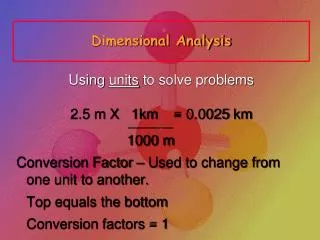
Successful problem solving(looking for a pattern) 3 parts to a problem: known beginning Desired end Connecting path or conversion factor
Example An object is traveling at a speed of 7500 centimeters per second. Convert the value to kilometers per day. Known: and Desired:
What relationships exist between units given and base units for length? Between second and day? Write them down.
Use these relationships as ratios in such a way that seconds, minutes, hours, centimeters, and meters divide out.
Your body contains approx. 100 trillion cells. Express this number in scientific notation.
If you are going 50 miles per hour, how many feet per second are you traveling?
If we pour out 100ml from a gallon of water, what would it weigh? Note: 1 gallon = 3.78 L also 1g =1ml=1cm3 (for water)