Understanding the Present Simple: Affirmative and Negative Statements, and Questions
This guide provides insights into the present simple tense, focusing on forming affirmative statements with ordinary verbs and the SHIT rule for third-person singular. It covers possession with "to have" and "have got," along with the correct formulation of negative statements in English, Dutch, and French. Additionally, it explains how to construct questions using different question words (who, what, where, when, why, how) and offers relevant exercises to practice the concepts effectively.

Understanding the Present Simple: Affirmative and Negative Statements, and Questions
E N D
Presentation Transcript
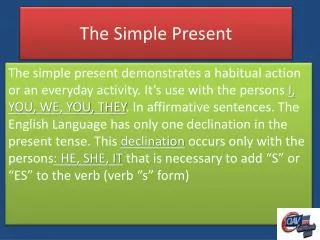
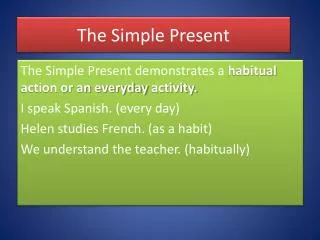
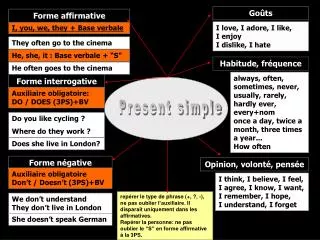
AFFIRMATIVE STATEMENTS • Ordinaryverbs follow the SHIT rule: • Third person singularSHE / HE / IT →infinitive + s → e.g. “He works.”
POSSESSION (BEZIT) • ‘to have’ & ‘have got’ • the verb ‘have got’ is notused in fixedexpressions: • e.g. ‘to have breakfast’ • exercise 4.9 WB p. 97 (ind) • oralexercise: ‘Haveyougot … ?’
NEGATIVE STATEMENTS • FORM • Dutch: ‘Het regentniet.’ • French: ‘Ilnepleutpas.’ • English: ‘It doesnotrain.’ • → do / does + not + infinitive don’t / doesn’t
NEGATIVE STATEMENTS • UITZONDERINGEN • tobe: ‘I amnota dragon.’ • can: ‘I cannot / can’tspeakChinese.’ • have got: ‘We have notgottennis courts at our school.’
NEGATIVE STATEMENTS • EXERCISES • exercise 4.13 WB p. 100 (in pairs) • exercise4.15 WB p. 102 (ind) • TB p. 77 →theory
QUESTIONS • Question words • who→ person / people • what→ things / animals • where→ places • when→ times / dates • why→ the reason of something • how→way / manner
QUESTIONS • STRUCTURE • e.g. “How doyougoto school?” • →do / does + pp (pers vnw) + infinitive • uitz.: • tobe: “Whereis the swimming pool?” • can: “Whichsportscanyoupractisehere at school?” • have got: “Haveyougot a dog?”
QUESTIONS • Vertaal • “Wat doe je na de lessen?” (after the lessons) • “Waarom leven zij in England?” • “Wanneer ga je weg?” (go away) • “Wie is hij?” • “Met wie speel je?” (spelen met = toplaywith) • “Waar spreken we af?” (afspreken = to meet)
QUESTIONS • EXERCISE • exercise 4.18 WB p. 105 (ind)