A Critical Evaluation of Plato's Life and Political Thought (427-347 BCE)
This comprehensive analysis explores Plato's life, highlighting his upbringing in war-torn Athens, connection to Socrates, disenchantment with politics, and founding of the Academy. It examines his political thought, including the cyclical nature of governments, the quest for the ideal society, and the classification of virtues and classes. Key themes include justice defined as "giving every man his due," the concept of philosopher-kings, and the significance of ideology. The evaluation also questions the implications of Plato's ideas on justice, equality, and political stability.
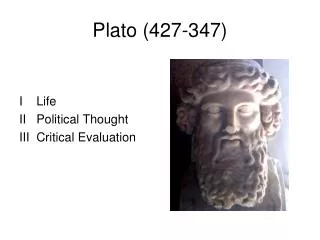

A Critical Evaluation of Plato's Life and Political Thought (427-347 BCE)
E N D
Presentation Transcript
I Life II Political Thought III Critical Evaluation Plato (427-347)
I Life • Born 427 in Athens during war • Politically connected; student of Socrates • Disillusionment with politics and turn to philosophy • Founding of the Academy 386 • Writes politeia around 375 • Trips to Sicily 367 / 361 • Two later works: politikon and nomoi
I Life II Political Thought III Critical Evaluation Plato (427-347)
Political Thought • Cycle of governments oligarchy – democracy – tyranny (562a) 2 Search for the best society division of labour (374) 3 virtues: wisdom / courage / self-discipline (432) 3 classes: rulers / soldiers / workers (415) • Justice “give every man his due,” (331e) or “minding your own business” (433b) 4 Search for the best polity the collective life of guardians (416d, 457d) the philosopher-kings (473c) the role of ideology (414c_ social equality (421d) and territorial self-sufficiency (423b)
I Life II Political Thought III Critical Evaluation Plato (427-347)
III Critical Evaluation • Class justice? • Conditions for political stability Leadership Ideology Equality (but some are more equal than others) • What is platonic about Plato? are we all cavemen? (514a)