Download
1 / 1
10 likes | 143 Views
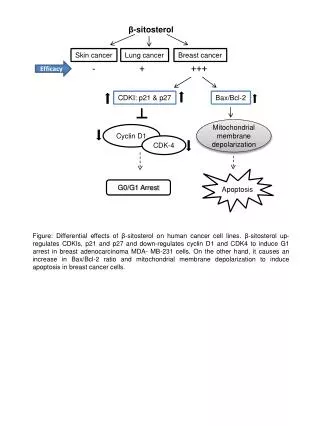
This study explores the differential effects of β-sitosterol on human cancer cell lines, particularly focusing on its role in breast adenocarcinoma MDA-MB-231 cells. It highlights how β-sitosterol up-regulates cyclin-dependent kinase inhibitors (CDKIs) like p21 and p27, while down-regulating cyclin D1 and CDK4, leading to G1 phase arrest. Additionally, the compound increases the Bax/Bcl-2 ratio and induces mitochondrial membrane depolarization, promoting apoptosis in breast cancer cells. These findings underscore the potential of β-sitosterol as a therapeutic agent in breast cancer treatment.

E N D
β-sitosterol Skin cancer Lung cancer Breast cancer - + +++ Efficacy CDKI: p21 & p27 Bax/Bcl-2 Mitochondrial membrane depolarization Cyclin D1 CDK-4 Apoptosis G0/G1 Arrest Figure: Differential effects of β-sitosterol on human cancer cell lines. β-sitosterol up-regulates CDKIs, p21 and p27 and down-regulates cyclin D1 and CDK4 to induce G1 arrest in breast adenocarcinoma MDA- MB-231 cells. On the other hand, it causes an increase in Bax/Bcl-2 ratio and mitochondrial membrane depolarization to induce apoptosis in breast cancer cells.