Download
1 / 21
220 likes | 389 Views
This paper explores innovative control concepts for active steering systems in trailers, focusing on low-speed and high-speed testing outcomes. It discusses path following strategies, articulation angles, and tire force equalization, with practical tests conducted on roundabouts and lane changes. Utilizing a Virtual Driver Model, the research aims to minimize lateral acceleration and maintain path accuracy, ultimately enhancing maneuverability, productivity, and safety. Key findings reveal improved handling, reduced tire wear, and enhanced stability at high speeds, crucial for light commercial vehicles.

E N D
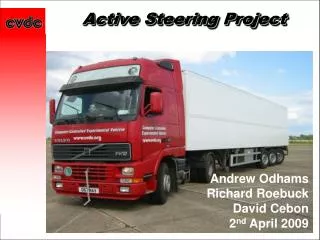
Active Steering Project Andrew Odhams Richard Roebuck David Cebon 2nd April 2009
Contents • Control concept • Low speed testing • High speed testing • Conclusions
ACTIVE STEERING Lead Point Follow Point • Controller • Low speed • High speed • Conclusions • Define Lead point and follow point • Calculate articulation angle of a perfect tracking trailer • Steer in relation to difference between real and ideal articulation angle • Set individual wheel angles to equalise tyre forces
PATH FOLLOWING TESTS 11.25m 8.9m 12.5m 5.3m • Controller • Low speed • High speed • Conclusions UK Roundabout Test
LOW SPEED ROUNDABOUT • Controller • Low speed • High speed • Conclusions • Unsteered:
LOW SPEED ROUNDABOUT • Controller • Low speed • High speed • Conclusions • Command Steer:
LOW SPEED ROUNDABOUT Locked Command CVDC • Controller • Low speed • High speed • Conclusions • Offtracking of 5th Wheel:
LOW SPEED ROUNDABOUT CVDC Command Locked • Controller • Low speed • High speed • Conclusions • Offtracking of Trailer Rear:
LOW SPEED ROUNDABOUT • Controller • Low speed • High speed • Conclusions • Tail Swing: Command Locked Path Following • Tail swings into blind spot
LATERAL TYRE FORCES Unsteered: • Controller • Low speed • High speed • Conclusions
LATERAL TYRE FORCES • Controller • Low speed • High speed • Conclusions • Unsteered: • FIXED TRAILER: 36.6 kN
LATERAL TYRE FORCES • Controller • Low speed • High speed • Conclusions • Path following Strategy: • CT-AT TRAILER: 6.1 kN
Rollover Prevention • Controller • Low speed • High speed • Conclusions • Rationale • Reduce the risk of rollover by controlling the path of the trailer • Optimal linear control strategy • Minimise lateral acceleration • Maintain acceptable path error • Virtual Driver Model • Original path following controller is nonlinear • ‘Virtual driver model’ performs same function using linear control
Virtual Driver Modelof Trailer Steering Y Current position of 5th wheel Semi-trailer Tractor X O uT Snapshot of tractor semi-trailer and path of 5th wheel at time instant k • Controller • Low speed • High speed • Conclusions
Optimal Control Strategy Discrete-time equations for vehicle and path of 5th wheel The control objectives The cost function where and Path error Lateral Accel’n Steering effort • Controller • Low speed • High speed • Conclusions
Results continued Manoeuvre: Lane change Vehicle speed: 88km/h Fixed value of Q1/R=0.05 • Controller • Low speed • High speed • Conclusions
Selection of weighting value 25% reduction Conventional Q2/R=0.005 Manoeuvre: Lane change Vehicle speed: 88km/h Fixed value of Q1/R=0.05 • Controller • Low speed • High speed • Conclusions
Path errors in lane change • Controller • Low speed • High speed • Conclusions
After lane change • Controller • Low speed • High speed • Conclusions V=88km/h Locked Path Following Control
PERFORMANCE MEASURES • Controller • Low speed • High speed • Conclusions
Conclusions Improved low-speed manoeuvrability Improved productivity (LCV) Improved safety Reduced tyre scrub Reduced tyre wear Reduced vehicle wear Improved high-speed stability 25% LTR reduction with no increase of PE Important for LCV