Download
1 / 11
110 likes | 267 Views
This document presents Dr. Mark Levinson's preliminary statistical comments on the safety and efficacy of Pfizer's gabapentin and pregabalin, presented during a joint FDA advisory committee meeting on July 10, 2008. The comments highlight unique prescribing patterns, review additional data from recent trials, and discuss potential biases in the FDA's analysis of rare events. By examining classical odds ratio methods and Bayesian models, the findings indicate that the sponsor's analyses do not support claims of biased conclusions from the FDA's analyses of gabapentin and pregabalin.

E N D
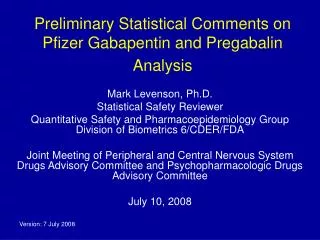
Preliminary Statistical Comments on Pfizer Gabapentin and Pregabalin Analysis Mark Levenson, Ph.D. Statistical Safety Reviewer Quantitative Safety and Pharmacoepidemiology Group Division of Biometrics 6/CDER/FDA Joint Meeting of Peripheral and Central Nervous System Drugs Advisory Committee and Psychopharmacologic Drugs Advisory Committee July 10, 2008
Sponsor Major Points • Gabapentin and pregabalin have unique mechanisms and prescribing patterns • Additional pregabalin trial data are now available since original submission • FDA analysis of rare events may lead to biased conclusions
Additional Pregabalin Trial Data • Additional data submitted April 30, 2008 • Trials available as of Jan. 1, 2008 • Sponsor numbers: Original submission: 10,429 patients Updated submission: 13,314 patients Difference: 2,885 patients 1 additional event (placebo suicide) • FDA has not reviewed additional data • Inclusion criteria • Indication • Duration
Sponsor Analysis of Rare Events • Sponsor examined • 4 classical odds ratio methods • 2 Bayesian models • 1 risk difference method
Classical Odds Ratio Methods • Mantel-Haenszel • Logistic regression • Mantel-Haenszel with continuity correction • Dersimonian-Laird with continuity correction • FDA discussed, in 2006 adult antidepressant review, effect of continuity correction in reducing OR
Pregabalin ORFDA inclusion criteria • FDA primary method: 1.88 (0.41, 13.58) Sponsor estimates • Mantel-Haenszel: 1.78 (0.39, 8.16) • Logistic regression: 1.89 (0.38, 9.38) • Mantel-Haenszel w/cc: 0.86 (0.28, 2.63) • Dersimonian-Laird w/cc: 0.85 (0.26, 2.80)
Bayesian Models (General) • Two components • “Prior” information on parameters • Model of data given parameters • Features • Permits probability statements • Stabilizes estimation (inclusion of zero-event trials) • Allows use of prior information • Caveats • Different prior information or different models give different results • Sensitivity and diagnostics vital
Sponsor Bayesian Model • No justification given for particular model and prior out of many possibilities • Uses zero-event trials. However, not demonstrated if model improves or worsens estimates. • Reference to analytical or simulation studies demonstrating appropriateness of model would be valuable • Diagnostics and results of sensitivity analysis not provided
Conclusions • Sponsor analyses do not support that FDA primary and sensitivity analyses led to biased conclusions • FDA conclusions for gabapentin and pregabalin based on overall patterns and findings of 11 drugs