Download

1 / 17
170 likes | 391 Views
The Structure of:. DNA. Objectives:. By the end of the day, you should: Know what DNA stands for Understand the shape of DNA and be able to label all parts Know the pairs of nucleotides Know how DNA is used. What is DNA?. DNA is the molecule that carries genetic information

E N D
Objectives: • By the end of the day, you should: • Know what DNA stands for • Understand the shape of DNA and be able to label all parts • Know the pairs of nucleotides • Know how DNA is used
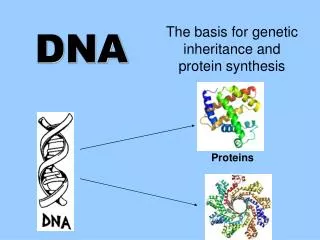
What is DNA? • DNA is the molecule that carries genetic information • So what does that really mean?
“DNA” • DNA stands for deoxyribonucleic acid • We’ll come back to this one…
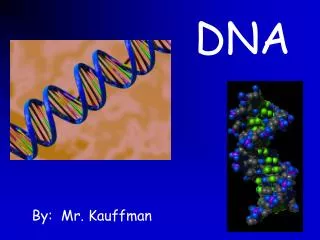
The Shape • The shape of the DNA molecule is called a double helix • Think of DNA’s shape as a ladder that has been twisted Straight Twisted Ladder Ladder
A Closer Look • It’s nice to think of DNA looking nice and simple like this:
A Closer Look • But, it really looks more like this: Let’s break it down…
The “Sides” • Each side of the ladder is called a sugar-phosphate backbone this part
The “Sides” • The sugar-phosphate backbone…up close • Consists of: • Phosphate group • Deoxyribose sugar group
The “Rungs” • The rungs of the latter are made up of nitrogenous bases • Bonded to the sugar group • There are 4 different kinds of bases in DNA…
The Bases Purines Pyrimidines
Nucleotide • A deoxyribose sugar group and a phosphate group and a nitrogenous base make up a nucleotide P P Adenine Cytosine P P Thymine Guanine
Putting it Together • The deoxyribose sugar group of one nucleotide bonds to the phosphate group of another nucleotide to form the sugar-phosphate backbone • The nitrogenous bases of one sugar-phosphate backbone bond to the nitrogenous bases of the other sugar-phosphate backbone to make base pairs • A only bonds with T • G only bonds with C
Putting it Together • Quick Practice: • If you had a strand of DNA where one side had this sequence of bases: ATAGGCAT • What would the other side’s sequence be???
Putting it Together P P C G P P A T P P C G P P A T
Use? • Now that you know about the structure of DNA, let’s revisit its function…
Use? • Short version: DNA stores genetic information • Long version: The sequence (order) of bases on the strand of DNA is a code for a blueprint of hundreds of thousands of different proteins that, when made, make up living things