Download
1 / 16
160 likes | 284 Views
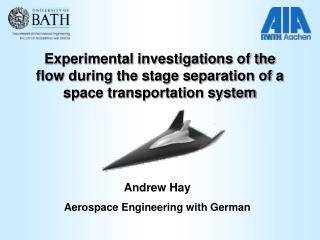
This study examines the airflow during the stage separation of the ELAC 1 and EOS two-stage space transportation system. Conducted in a 40 cm x 40 cm "Trisonic" wind tunnel at a range of Mach numbers, the experiment utilizes oil flow patterns and color Schlieren photography to visualize flow dynamics and shock interactions at an altitude of 31 km. Results indicate that no shock-induced boundary layer separation was observed, with the shock system showing weak intensity, influenced significantly by 3D effects within the test section.

E N D
Experimental investigations of the flow during the stage separation of a space transportation system Andrew Hay Aerospace Engineering with German
Project Brief • The ELAC 1 and EOS configuration is a two-stage-to-orbit space transportation system • Stage separation occurs at Mach number Ma = 6.8 and at an altitude of 31 km • Flow visualisation - Oil flow pattern and colour Schlieren photography • Static wall pressure measurement • Identify aerodynamic interaction effects
Experimental Set-Up • 40cm x 40cm “Trisonic” Wind Tunnel • 1:150 scale EOS upper stage model and flat plate to simulate ELAC 1 lower stage • Test Parameters: • Freestream Mach number (Ma = 2.0 to 2.2) • Relative angle of attack (Δα = -5° to +10 °)
Test Geometry • Relative separation distance also planned but not possible
Flow Visualisation • Oil flow pattern - to visualise the near surface flow.Emulsion of oil and pigments move along wall shear stress flow lines. • Colour Schlieren photography - to visualise the shock system. Density gradients are made visible, because refraction index changes with density. Pressure Measurement • Pressure coefficient Cp calculated from difference between static wall pressure p and ambient pressure p0.
Oil Flow Pattern • EOS bow shock impingement line on flat plate is visible • No shock induced boundary layer separation is visible • Reflected shock impingement line is not visible on EOS model
Colour Schlieren • Observed shock system very weak • Shock geometry used with shock theory to calculate flow conditions • Disturbances from flat plate very visible
Pressure Measurement • Shock impingement points visible (pressure increase) • Overall trend is a decrease in pressure downstream • Reason - 3D effects of the closed wind tunnel test section
Results Discussion • No boundary layer separation observed - confirmed by Schlieren and comparison with experimental data. • Shock systems very weak - shock intensities very close to 1 • 3D effects of test section have a stronger influence on the pressure results than the shock system • Comparison of testing methods:All test methods consistent in providing location of shock impingement points. Schlieren is best for visualising system.
Conclusions • Shock systems visible, but very weak at tested Mach numbers • No shock induced boundary layer separation observed • 3D effects of the closed test section had a significant influence on the results • Improved test set-up is required to enable testing at more parameter variables
Experimental investigations of the flow during the stage separation of a space transportation system Andrew Hay Aerospace Engineering with German
Colour Schlierem Photo Ma = 2.0 = +5° h = 40mm
Static Wall Pressure Measurement Ma = 2.0 = +5° h = 40mm