Exploring the Physics of Balloon-Powered Cars: A Race Against Time
In our science fiction project, we delve into the dynamics of balloon-powered cars, converting race times from meters-per-second to miles-per-hour. This report summarizes our experimental results, highlighting the impact of various variables on speed and performance. Students are tasked with drafting a clear and neat summary, including a conversion chart, data table, and conclusions backed by math. Our observations reveal contrasting performances among participants, showcasing how small design flaws can dramatically affect outcomes. Let's engage in this exciting scientific exploration!

Exploring the Physics of Balloon-Powered Cars: A Race Against Time
E N D
Presentation Transcript
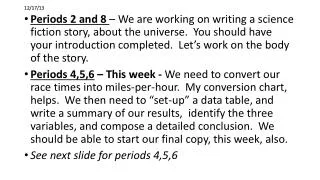
12/17/13 • Periods 2 and 8 – We are working on writing a science fiction story, about the universe. You should have your introduction completed. Let’s work on the body of the story. • Periods 4,5,6 – This week - We need to convert our race times into miles-per-hour. My conversion chart, helps. We then need to “set-up” a data table, and write a summary of our results, identify the three variables, and compose a detailed conclusion. We should be able to start our final copy, this week, also. • See next slide for periods 4,5,6
Final race car project report • Question • Hypothesis • Variables • Procedure • show all the math work to convert from meters-per-second to miles-per-hour • data table/written results, • Graph • Conclusion • needs to be presented in a nice neat manner, on clean sheets of untorn, unmarred paper. Legible handwriting is a must and spelling, grammar and punctuation is a must.
10 meters = .0055 miles5 seconds = .0014 hours Rate of speed = .0057/.0014 = 3.9 mph
Data table and results My Balloon Car Race results My car ran smoothly, as the air let out of the balloon, the car sped forward. I was able to go a complete 10-meters in just five seconds. However, Fred was not so lucky. First, the small wheels on his car would not roll, freely, and his balloon was dragging on the floor, in front of his car. It finally travelled two extra meters when the balloon lifted off the ground and propelled his car forward. Barney did not attach a straw to his balloon. He simply attached the balloon to the car with sticky tape. Without the straw, all the air blew out of the balloon, at once. The momentum it created caused Barney’s car to roll freely for 6 meters.