Download
1 / 14
140 likes | 260 Views
This section explores the fundamental concepts of activation energy (Ea) and its relationship with temperature on reaction rates. It discusses the Arrhenius equation, which quantifies how temperature influences reaction kinetics through a frequency factor and activation energy. Key trends are highlighted: as activation energy and temperature vary, so does the reaction rate. Additionally, graphical methods for determining Ea from experimental data are explained, illustrating the numerical connections between Ea, temperature, and the rate constant (k).

E N D
Section 14.5 Activation Energy and Temperature Bill Vining SUNY Oneonta
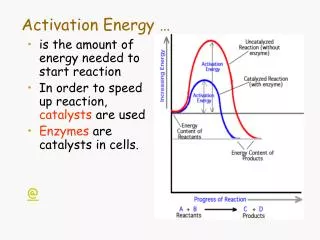
Activation Energy and Temperature In this section… Reaction coordinate diagrams The Arrhenius equation Temperature, Ea and k Graphical determination of Ea
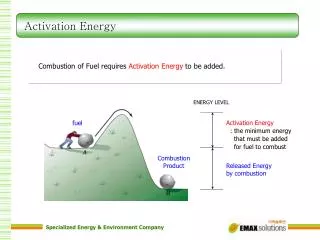
Activation Energy, Temperature and Rate • Trends: • As Ea decreases, rate increases • As T increases, rate increases
The Arrhenius Equation Trends: As T↑: As Ea↑: k = rate constant A = frequency factor Ea = activation energy R = gas constant (8.3145 J/K ∙mol) T = temperature (K)
The Arrhenius Equation: Two Point Version General Use: There are five variables. If you know 4 of Them you can solve for the 5th. k1= rate constant at temperature 1 k2= rate constant at temperature 2 T1= temperature 1 (K) T2= temperature 2 (K) Ea= activation energy R = gas constant (8.3145 J/K ∙mol)
The Arrhenius Equation: Two Point Version The activation energy for the gas phase decomposition of t-butyl propionate is 164 kJ. C2H5COOC(CH3)3(g) (CH3)2C=CH2(g) + C2H5COOH(g) The rate constant for this reaction is 3.80 × 10⁻⁴ s-1at 528 K. What is the rate constant at 569 K?
The Arrhenius Equation: Two Point Version The rate of a reaction triples when the temperature is increased from 280 oC to 300 oC. What is the activation energy?
The Arrhenius Equation: Graphical Determination of Ea k = rate constant A = frequency factor Ea = activation energy R = gas constant (8.3145 J/K ∙mol) T = temperature (K) y = b + m x Collect k vs. temperature data Plot ln(k) vs. 1/T Ea = - slope x R