
Tabu Search Technique Applied: Iterative Sequence Transformation and Neighborhood Analysis
This exercise involves applying the tabu search technique starting with the initial sequence of 2, 1, 4, 3. Two scenarios are evaluated: maintaining a tabu list length of 1 and 3 for four iterations each. The objective is to analyze the neighborhood schedules obtained through adjacent pairwise interchanges and calculate the respective fitness functions (F) for various sequences. The results show an optimization process highlighting the tabu lists and subsequent outcomes, aiming to identify the best sequence while observing the limitations of the tabu search method.

Tabu Search Technique Applied: Iterative Sequence Transformation and Neighborhood Analysis
E N D
Presentation Transcript
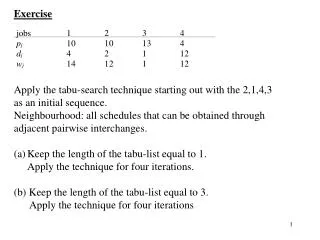
Exercise Apply the tabu-search technique starting out with the 2,1,4,3as an initial sequence. Neighbourhood: all schedules that can be obtained throughadjacent pairwise interchanges. (a) Keep the length of the tabu-list equal to 1. Apply the technique for four iterations. (b) Keep the length of the tabu-list equal to 3. Apply the technique for four iterations
S1 = 2, 1, 4, 3 F(S1) = wjTj = 12·8 + 14·16 + 12·12 + 1 ·36 = 500 = F(Sbest) F(1, 2, 4, 3) = 480 F(2, 4, 1, 3) = 436 = F(Sbest) F(2, 1, 3, 4) = 652 Tabu-list: { (1, 4) } S2 = 2, 4, 1, 3, F(S2) = 436 F(4, 2, 1, 3) =460 F(2, 1, 4, 3) tabu! F(2, 4, 3, 1) = 608 Tabu-list: { (2, 4) } S3 = 4, 2, 1, 3, F(S3) = 460 F(2, 4, 1, 3) tabu! F(4, 1, 2, 3) = 440 F(4, 2, 3, 1) = 632 Tabu-list: { (2, 1)} (a)
S4 = 4, 1, 2, 3, F(S4) = 440 F(1, 4, 2, 3) =408 = F(Sbest) F(4, 2, 1, 3) tabu! F(4, 1, 3, 2) = 586 Tabu-list: { (4, 1) } F(Sbest)= 408
(b) S1 = 2, 1, 4, 3 F(S1) = 500 = F(Sbest) F(1, 2, 4, 3) = 480 F(2, 4, 1, 3) = 436 = F(Sbest) F(2, 1, 3, 4) = 652 Tabu-list: { (1, 4) } S2 = 2, 4, 1, 3, F(S2) = 436 F(4, 2, 1, 3) =460 F(2, 1, 4, 3) tabu! F(2, 4, 3, 1) = 608 Tabu-list: { (2, 4), (1, 4) }
S3 = 4, 2, 1, 3, F(S3) = 460 F(2, 4, 1, 3) tabu! F(4, 1, 2, 3) = 440 F(4, 2, 3, 1) = 632 Tabu-list: { (2, 1), (2, 4), (1, 4) } S4 = 4, 1, 2, 3, F(S4) = 440 F(1, 4, 2, 3) tabu F(4, 2, 1, 3) tabu! F(4, 1, 3, 2) = 586 Tabu-list: { (2, 3), (2, 1), (2, 4) } F(Sbest)= 436not optimal !

![[Exercise Name] Functional Exercise](https://cdn0.slideserve.com/621913/exercise-name-functional-exercise-dt.jpg)

![[Exercise Name] Functional Exercise](https://cdn1.slideserve.com/1717560/exercise-name-functional-exercise-dt.jpg)









![[Exercise Name] Functional Exercise](https://cdn3.slideserve.com/6680259/exercise-name-functional-exercise-dt.jpg)
![[Exercise Name] Tabletop Exercise](https://cdn4.slideserve.com/9191716/exercise-name-tabletop-exercise-dt.jpg)