Download
1 / 3
30 likes | 138 Views
Learn how to calculate annualized rates, convert periodic rates, and determine future and present values to optimize your financial strategies. Understand nominal rates versus effective annual yield for smarter investments.

E N D
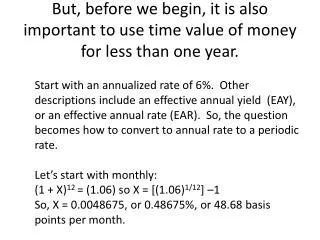
But, before we begin, it is also important to use time value of money for less than one year. Start with an annualized rate of 6%. Other descriptions include an effective annual yield (EAY), or an effective annual rate (EAR). So, the question becomes how to convert to annual rate to a periodic rate. Let’s start with monthly: (1 + X)12 = (1.06) so X = [(1.06)1/12] –1 So, X = 0.0048675, or 0.48675%, or 48.68 basis points per month.
Now, let’s figure out how much 100,000 is worth for one month at an annualized rate of 6%. 100,000(1.0048675) =$100,486.75 What about 2 months? 100,000(1.0048675)2 =$100,975.87 Another, and easier way to do this is 100,000(1.06)(2/12) = =$100,975.87 So, in general, FV = PV(1+EAR)(h/n) And, of course PV = FV/(1+EAR)(h/n) Where h = # of periods and n = the # of total periods in a year
If the interest rate is a nominal rate, also referred to as a stated rate, you treat this differently: Suppose we have a nominal rate of 6%, but paid monthly for the same $100,000. Then, FV = 100,000(1 + .06/12) = $100,500 And for 2 months, 100,000(1.005)2 = 101,002.50. Notice the difference compared to using an EAY or EAR is about $27 more interest for this example.