Macroinvertebrates: Why?
510 likes | 531 Views
Learn why macroinvertebrates are abundant and crucial as water quality indicators. Discover easy collection methods and identification tips. This article covers sampling details, site characteristics, and species examples.

Macroinvertebrates: Why?
E N D
Presentation Transcript
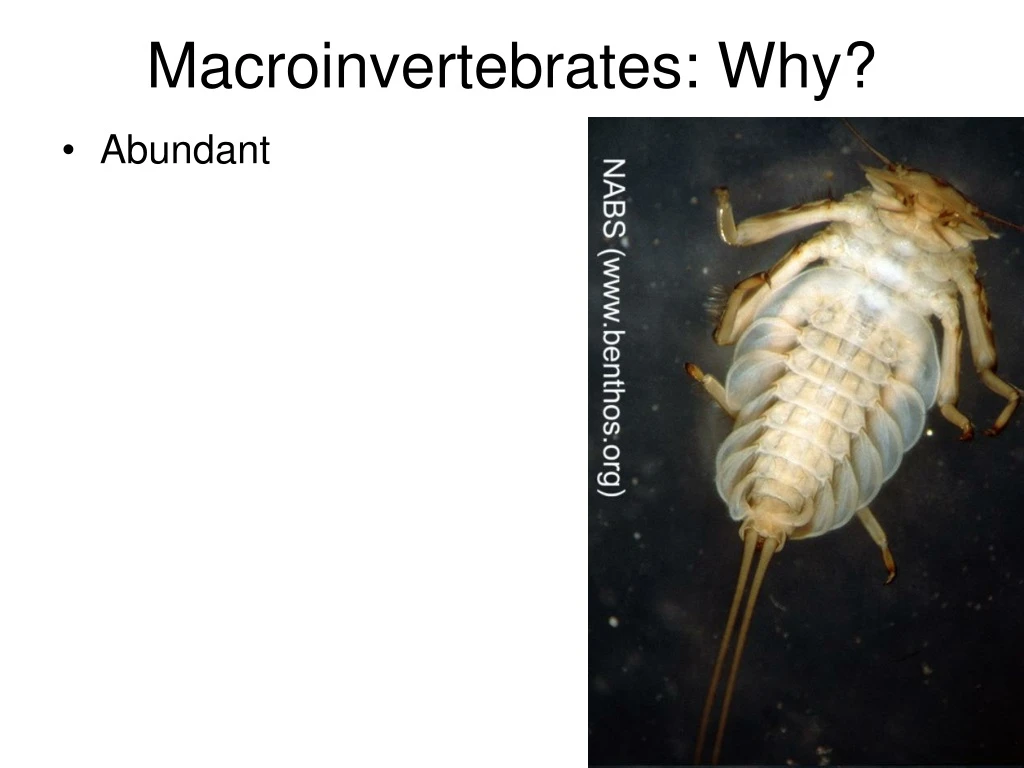
Macroinvertebrates: Why? • Abundant
Macroinvertebrates: Why? • Abundant • Easy to collect
Macroinvertebrates: Why? • Abundant • Easy to collect • Fairly easy to identify
Macroinvertebrates: Why? • Abundant • Easy to collect • Fairly easy to identify • Water quality indicators • Very responsive to: • Particles • Land use
Macroinvertebrates: Why? • Abundant • Easy to collect • Fairly easy to identify • Water quality indicators • Very responsive to: • Particles • Land use • Of interest to VT DEC as screening tool • Fish Food • Disease Vectors • Cool
Abundant Image sources: Wikimedia commons; NABS; McCabe lab group (undergraduate students from SMC and UVM – most by Erin Hayes Pontius
Easy to Collect • ‘Kick’ samples • Water flow • Disturb substrate for fixed time interval
Easy to Collect • Remove sample from kick net • Sieve sample • Discard water • Preserve bugs in ethanol • LABEL!!
Sample labels • Example: Brown’s River @ Cambridge Road Westford, Vermont, USA 44.612284,-73.008356 March 24 2008 Col. Declan McCabe 080324001
Labeling • Pencil on paper (card stock) • Transfer information to field note book • Add sample code to field sheets • Placed in sample • Preserve sample in 100% Ethanol
Sample fate • All samples, field sheets, field note books stay with project • Data uploaded ASAP
Easy to CollectSampling details • Minimum of 4 samples per site • Each is a 30-second ‘kick’ sample • Bagged separately • Small streams only & All samples in riffles – Why?
Easy to CollectSampling details • Minimum of 4 samples per site • Each is a 30-second ‘kick’ sample • Bagged separately • Small streams only & All samples in riffles – Why? • Highest diversity
Easy to CollectSampling details • Minimum of 4 samples per site • Each is a 30-second ‘kick’ sample • Bagged separately • Small streams only & All samples in riffles – Why? • Highest diversity • Consistent habitat type
Easy to CollectSampling details • Minimum of 4 samples per site • Each is a 30-second ‘kick’ sample • Bagged separately • Small streams only & All samples in riffles – Why? • Highest diversity • Consistent habitat type • Easier to sample consistently
Easy to CollectSampling details • Minimum of 4 samples per site • Each is a 30-second ‘kick’ sample • Bagged separately • Small streams only & All samples in riffles – Why? • Highest diversity • Consistent habitat type • Easier to sample consistently • Safer sampling
Site Characteristics: Safer Sampling? Image sources: Wikimedia commons; NABS; McCabe lab group (undergraduate students from SMC and UVM – most by Erin Hayes Pontius Home
Site Characteristics: Safer Sampling? • Riffles • Shallow (safer) and good potential for light penetration • Flowing water • Lots of oxygen – gills work well • Food delivered • Staying put - Hang on for dear life
Staying put: be flat Image sources: Wikimedia commons; NABS; McCabe lab group (undergraduate students from SMC and UVM – most by Erin Hayes Pontius Home
Staying put: ballast Image sources: Wikimedia commons; NABS; McCabe lab group (undergraduate students from SMC and UVM – most by Erin Hayes Pontius Home
Staying put: anchor to substrate Image sources: Wikimedia commons; NABS; McCabe lab group (undergraduate students from SMC and UVM – most by Erin Hayes Pontius
Fairly Easy to Identify: in the lab • Samples: • Picked • IDed • Photographed • Data uploaded
Fairly Easy to Identify: Details Dichotomous Keys - Dich (two);Tome (a cut section of a papyrus roll) We will use these sometimes: 1a. Three pairs of jointed legs……………………………2. 1b. Jointed legs not present………………………………3. We will use these more often: ID to order on the old web site: http://academics.smcvt.edu/Vermont_rivers/Help/Identifying%20to%20Order.htm ID to family / genus on new web site: http://wikieducator.org/Streams/home
Macroinvertebrates ‘Big’ invertebrates
Life cycle example • Eggs in Nov. • Larval growth until May • Pupation until Oct. • Adults complete cycle in Early Nov.
Two claws Two ‘tails’ Stoneflies: Plecoptera
True flies: Diptera; no legs; adults have two wings
Trichoptera: Caddisflies • Frequently build cases or nets • All use silk • Adults have hairy wings • All larvae have anal claws
Ephemeroptera: mayflies One claw Three ‘tails’
Ephemeroptera: mayflies Adults: Wings held vertically
Megaloptera: dobsonflies: there is little on earth you could confuse it with
Odonata • Anisoptera (dragonflies) Zygoptera (damselflies)
Eggs in Nov. • Larval growth until May • Pupation until Oct. • Adults complete cycle in Early Nov.
Mollusca: clams and snails http://eol.org/pages/50249/overview http://eol.org/data_objects/19130282
Land use, water quality and insects Slide from Brian Cunningham
P-value = 0.0016 Land use, water quality and insects
Land use, water quality and insects Potash Snipe Home