Population and Speciation
This comprehensive overview explores the principles of population genetics and the speciation process from a genetic perspective. It highlights trait variations, allele frequencies, and the gene pool's significance in a population. Key concepts like the Hardy-Weinberg equilibrium, mutation, migration, genetic drift, and natural selection are discussed to illustrate how populations evolve over time. The mechanisms of speciation, including geographic and reproductive isolation, are examined, along with the rates of species formation, including the concept of punctuated equilibrium.

Population and Speciation
E N D
Presentation Transcript
Population and Speciation Population Genetics: The study of Evolution from a genetic point of view.
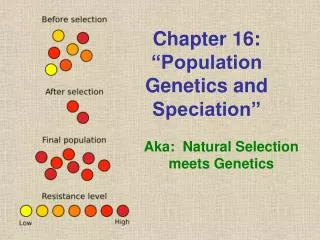
Variations of Traits • Biologists measure traits in large samples when studying variation. • Bell curves show that average populations have similar traits. A few display the extremes of a trait. • Varying genotypes arise in 3 ways • Mutations from flawed copies of genes • Recombination from an independent assortment of genes during meiosis • Random fusion of gametes, combination of one sperm and one egg.
Allele Frequency and the Gene Pool • Gene pool: the total genetic information available to a population • Allele frequency: determined by dividing the number of a certain allele by the total number of alleles of all types in a population. • Phenotype frequency: The number of individuals with a certain phenotype divided by the total number of individuals in a population.
Harvey-Weinberg Genetic Equilibriumbased on an ideal hypothetical population not evolving- This is not real life • 1. no net mutations occur • 2. individuals neither enter or leave a population • 3. The population is large • 4. individuals mate randomly • 5. Selection does not occur
Requirements for Genetic Equilibrium.Mutation: • Mutation: spontaneous mutation is slow over a longer period of time • Mutagens force mutations from chemical or radiation exposure • They produce new alleles that may be harmful or beneficial to a population
Migration • Immigration: the movement into a population • Emigration: the movement out of a population • Gene Flow: the process of genes moving from one population to another.
Genetic Drift • The phenomenon by which allele frequencies in a population change as a result of random events or chance. • Small populations experience a large amount of drift, they lose genetic diversity • Large populations maintain a small amount of genetic drift
Nonrandom Mating • Random mating doesn’t always occur in a population because of geographic proximity • Nonrandom mating is selection which may result in genes being to similar, which cause genetic disorders in a population • Selection of a mate based on similar characteristics is assortative mating
Natural Selection • Members of a species more likely to pass on their genes to the next generation • Stabilization selection: individuals with average form of a trait have the highest fitness • Directional selection: individuals that have a more extreme form of a trait have a greater fitness than those with average form of a trait. • Disruptive selection: individuals with extreme variation have greater fitness than the average form of a trait. • Sexual selection: Males must be selected by females based on traits that are desired. The genes of successful reproducers not just survivors are amplified through natural selection.
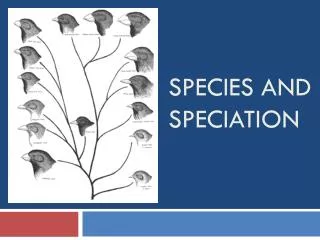
Concept of Species • Speciation: Some species are very similar to their ancestral species while other populations become quite different • Morphology: the internal and external structure and appearance of an organism • Biological species concept: a species is a population of organisms that can successfully interbreed but can not breed with other groups.
Isolating Mechanisms • Geographic isolation: physical separation • Reproductive isolation: barriers to successful breeding between groups in the same area. • Broad type: prezygotic-before fertilization and postzygotic-after fertilization
Rates of Speciation • Speciation may take millions of years, some may occur more rapidly, it may not occur smoothly and gradually. • Punctuated equilibrium: a sudden shift in form that is often seen in the fossil record.