Download
1 / 34
340 likes | 443 Views
This study investigates the probabilistic seismic hazards in the San Francisco Bay Area using advanced seismicity simulation techniques. The research integrates models by leading scientists to evaluate fault zone behaviors and stress parameters under different loading conditions. Key findings reveal that the viscoelastic earthquake simulator effectively captures the complexities of fault systems and adheres to established seismicity patterns, including Gutenberg-Richter statistics. The study underscores the simulator's efficacy in estimating key fault properties essential for probabilistic seismic hazard analyses.

E N D
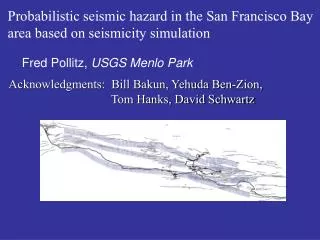
Probabilistic seismic hazard in the San Francisco Bay area based on seismicity simulation Fred Pollitz, USGS Menlo Park Acknowledgments: Bill Bakun, Yehuda Ben-Zion, Tom Hanks, David Schwartz
Capabilities of this simulator
Inherently discrete fault zone (Ben-Zion and Rice model) • Homogeneous, planar faults • Viscoelasticity of lower crust/upper mantle --> loading through backslip in the fully relaxed limit
This Study Virtual California (Rundle et al., 2004)
Stress history on a single fault patch Static frictional stress Dynamic frictional stress Arrest stress Dynamic overshoot parameter: D = (ss - sa)/(ss - sd) Stress reduction parameter: Ds = ss - sa
Hanks and Bakun (2007) D=1.1, Ds =7.5 MPa
Single-segment ruptures log10 [earthquake production rate (yr-1)] magnitude
Single and multi-segment ruptures log10 [earthquake production rate (yr-1)] magnitude
D=1.1 Ds =7.5 MPa M>6.7
Conclusions • Viscoelastic earthquake simulator is feasible • Fault system behavior is sensitive to simple parameters • Simulations capture Gutenberg-Richter and characteristic-earthquake behavior • Earthquake simulators can be used to estimate fault properties needed for PSHA: mean recurrence interval magnitude-frequency statistics coefficient of variation conditional rupture probability