Download
1 / 5
50 likes | 163 Views
This study aims to cross-evaluate eleven Level 4 Sea Surface Temperature (SST) fields, utilizing the Advanced Clear-Sky Product Output (ACSPO) Level 2 SST as a standard reference. By analyzing L4-L2 SST biases instead of brightness temperatures, the study minimizes computational challenges associated with the CRTM. Four metrics are employed for assessment: average bias, variability of bias, and their spatial and temporal measures. The results provide insights into global SST consistency, particularly focusing on the influence of ambient and transient cloud conditions on observations.

E N D
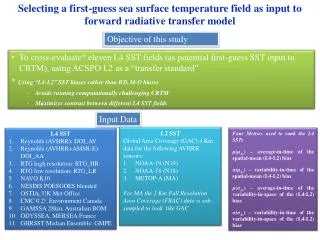
Selecting a first-guess sea surface temperature field as input to forward radiative transfer model Objective of this study • To cross-evaluate* eleven L4 SST fields (as potential first-guess SST input to CRTM), using ACSPO L2 as a “transfer standard” • * Using “L4-L2” SST biases rather than BTs M-O biases • Avoids running computationally challenging CRTM • Maximizes contrast between different L4 SST fields Input Data L2 SST Global Area Coverage (GAC) 4 Km data for the following AVHRR sensors: NOAA-19 (N19) NOAA-18 (N18) METOP-A (MA) For MA the 1 Km Full Resolution Area Coverage (FRAC) data is sub-sampled to look like GAC • Four Metrics used to rank the L4 SSTs • μ(μΔε) – average-in-time of the spatial-mean (L4-L2) bias • σ(μΔε) – variability-in-time of the spatial-mean (L4-L2) bias • μ(σΔε) – average-in-time of the variability-in-space of the (L4-L2) bias • σ(σΔε) – variability-in-time of the variability-in-space of the (L4-L2) bias L4 SST Reynolds (AVHRR): DOI_AV Reynolds (AVHRR+AMSR-E): DOI_AA RTG high resolution: RTG_HR RTG low resolution: RTG_LR NAVO K10 NESDIS POESGOES blended OSTIA, UK Met Office CMC 0.2o, Environment Canada GAMSSA 28km, Australian BOM ODYSSEA, MERSEA France GHRSST Median Ensemble: GMPE
Major results of this study (a) The time series of (a) global median (μΔε) for ΔTL4L2, (b) global RSD (σΔε) for ΔTL4L2 ,with L2 SST derived from Metop-A GAC data. • Typically, μ(μΔε) ~±70 mK and σ(μΔε) ~35mK (except ODYSSEA) • Typically, μ(σΔε) ~<500 mK and σ(σΔε) ~25mK • The GHRSST Multi-Product Ensemble (GMPE) and Canadian Meteorological Centre analysis (CMC-0.2o), show better consistency with ACSPO L2 SST Saha, K., A. Ignatov, X. M. Liang, and P. Dash (2012), Selecting a first-guess sea surface temperature field as input to forward radiative transfer models, J. Geophys. Res., 117, C12001, doi:10.1029/2012JC008384.
Ambient Cloud Dependency in MICROS Consistent Warm bias is seen in CRTM-Observation (M-O) BT differences globally a part of which may come from cold bias in “O” Contribution to Cooler Observations “O” could be from Ambient and/or Residual cloud Such Transient state clouds are difficult to detect using simple threshold-based Clear-sky mask
Concept of Number of Clear-Sky Ocean Pixels - NCSOP Center Clear-sky Pixel • Clear sky ocean pixel • Cloudy ocean pixel 100 Km NCSOP around each clear-sky pixel, calculated using sliding window technique, is used as (an inverse) proxy of ambient cloud 100 Km
An exponential fit developed using the Levenberg-Marquardt least-squares minimization to estimate this cloud contamination Ch5 Ch3B Ch4 X = NCSOP, with three following conditions: A0 ≡ Confidently clear-sky (NCSOP ∞) A0+ A1≡ Cloudy window (NCSOP 0) A1≡ Amplitude ; A2 ≡ Drop-off rate SST Results of this study will also be used to more accurately validate CRTM and its first guess input fields