OSETI with MAGIC
The exploration of Optical SETI (OSETI) using the MAGIC telescope offers new avenues in the search for extraterrestrial life. The principle of mediocrity and advancements in astrometry suggest that rocky, habitable planets are likely candidates for supporting life. The Drake equation provides a framework to estimate the number of intelligent civilizations in our galaxy. With its advanced optical capabilities, MAGIC can detect weak light pulses from distant stars, enhancing the prospects of discovering intelligent extraterrestrial communication. The search is ongoing, and only time will reveal the results.

OSETI with MAGIC
E N D
Presentation Transcript
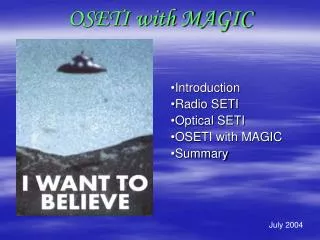
OSETI with MAGIC Introduction Radio SETI Optical SETI OSETI with MAGIC Summary July 2004
~ 110 Jupiter-like planets discovered so far. Earth-like planets still remains undetected due to the mass sensitivity limit of the experiments. Introduction • Philosophically: since the time of ancient Greek civilization, some people think that Earth is not a special place: • “Principle of Mediocrity”. • Scientifically: • recent development on Astrometry and Planetary Search: • rocky habitable planets expected to be found (NEWTON/TPF). • different environments can also evolve life taking profit of some different energy sources → planets evolving life much more probable. • After that, to become an intelligent kind of extra-terrestrial life could be just a question of time. 14th ISCRA Course, Erice 2004
Introduction Drake equation • The number N of intelligent communicative civilizations in our galaxy can be estimated by the known as Drake equation • where • R is the yearly rate at which stars form in the galaxy (1 yr-1) • fpis the fraction of stars that possesses planets (0.5) • n is the number of planets with environment suitable for life (2) • fl is the fraction of planets on which life actually develops (1) • fi is the fraction of these planets in which life develops intelligence (1) • fc is the fraction of intelligent life forms that developes a culture capable of interstellar communication (0.1) • L is the time that this culture will devote to communication (106 yr) • Supposing optimistic parameters → high N (e.g., those in brackets lead us to N = 105 communicative ETC) → Fermi Paradox: “where are they?” N = R · fp · n · fe · fi · fc · L 14th ISCRA Course, Erice 2004
Natural diffuse background SETI Radio SETI (traditional) Cocconi & Morrison (1959) → proposition of MASERS operating at HI frequency (1.4GHz). Moderate RF/MW background & high development of radio communication Frank D. Drake (Project Ozma, 1961) → first scientific search based on the idea of C&M, searching for HI emissions SETI programs now are restricted by radio-telescopes observations. Present searches: try to enhance their signal detection→ interference & instrumental background reduction. At the moment, there are no significant signal for any of the observed targets. 14th ISCRA Course, Erice 2004
Optical SETI (OSETI) • Based in optical LASER: • LASER devices have more power than MASER. • They operate in the optical range → higher bandwidth (faster transmission of information) & atmosphere transparency. • Pulsed emission ~ ns → less natural background (Cherenkov flashes). • →higher probability for success with more significant results. 14th ISCRA Course, Erice 2004
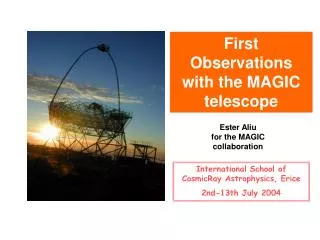
OSETI with MAGIC MAGIC is the largest optical reflector ever built. • 234 m2 mirror surface → high concentration of light. • time resolution about 1 ns → expected pulses (O(1ns)) could be resolved. • PMT’s able to detect pulses with few photons → weak luminosity excess could be detected from a star. 14th ISCRA Course, Erice 2004
PMT 1ns γ analogical pulse Single pixel threshold (discriminator level) Pulse rate Logical pulse COUNTER Energy/area|pulse ~ 8.1·10-20 J/m2 Telescope parameter (minimum value) OSETI with MAGIC Minimum pulse energy to get a Single Pixel Trigger • Single Pixel Threshold ~ 8 phe • Average QE ~ 20 % • Transmissions ~ 80 % • Mean λ for optical γ ~ 500 nm 14th ISCRA Course, Erice 2004
Adiverged beam LASER dt D Minimum Energy Emitted per Pulse ~ 24 kJ OSETI with MAGIC But LASER traveling : • for reasonable parameters: • dt~ 1m • D ~ 10 pc Helios ~ 3.6 MJ per 3 ns pulse !!! 14th ISCRA Course, Erice 2004
Nphe/ns detected~ 13.5 phe/ns ↓ P>8phe/ns~ 1.5·10-2 ↓ Δt ~ 1ns → OSETI with MAGIC What can MAGIC do just now? νLASER ≤ Rspt max to be detected, and also it must be above the Rspt accidental due to stars luminosity in a significant way. Rspt accidental can be estimated: for an F type star (like our Sun) with a magnitude 5.5, Nphe/ns NSB~ 0.13 phe/ns ҒEarth ≈ 2.52·10-8·10-0.4·m J·s-1·m-2 Rspt accidental~ 15 MHz Rspt Cherenkov~ 180 Hz Rspt max readable by MAGIC (expected) ~100 MHz 14th ISCRA Course, Erice 2004
OSETI with MAGIC • Following Kardashev’s civilization criteria (based on the energy resources employed): • KI (employing their planet) • KII (employing their star) • KIII (employing their whole galaxy) ←Helios (at 100 MHz) MAGIC parameters Dt =1m KI→ ↑ closest star Galactic ↑ Center 14th ISCRA Course, Erice 2004
Summary The MAGIC Telescope is working now, and Rspt data is taken. • After that, to find an intelligent kind of extra-terrestrial life could be just a question of time (spent in analysis)! 14th ISCRA Course, Erice 2004