Plate Tectonics
This guide explores the fundamental aspects of plate tectonics, emphasizing Earth's layers: the crust, mantle, and core. The continental crust is thick and ancient, while oceanic crust is thin and young. The lithosphere forms the Earth’s rigid outer layer, underlain by the slowly flowing asthenosphere. We discuss essential plate boundaries: divergent, convergent, and transform, and their connection to geological phenomena. Additionally, we touch on continental accretion, the supercontinent Pangea, and paleomagnetism's role in understanding Earth's historical magnetic field.


Plate Tectonics
E N D
Presentation Transcript
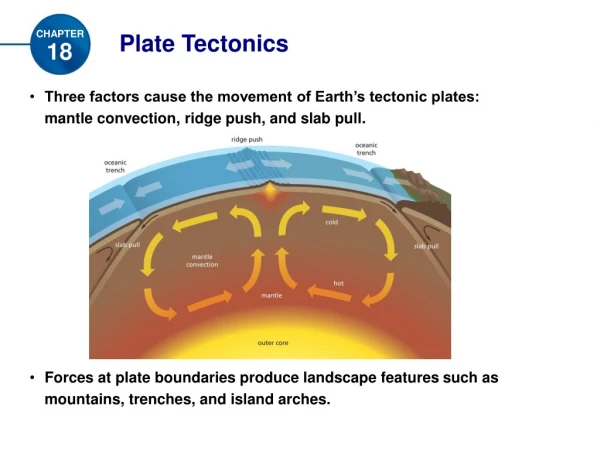
Geo Words Crust – the thin outermost layer of the Earth. Continental crust is relatively thick and mostly very old. Ocean crust is relatively thin, and always geologically very Young. Mantle – the zone of the earth below the crust and above the core. It is divided into the upper mantle the lithosphere and lower mantle with transition zone between. Lithosphere – the outermost layer of the earth, consisting of the earths crust and part of the upper mantle. The behaves as a rigid layer, in contrast to the underlying asthenosphere. Asthenosphere – the part of the mantle beneath the lithosphere . The asthenosphere undergoes slow flow, rather than behaving as a rigid block, like the overlying lithosphere.
Core – The core is mostly of iron, it is hot. The outer core is liquid and the inner core is solid because of the pressure coming form the earths others Suture Zone – the zone on the earths surface where two continents have collided and have been weldd together to from a single continent
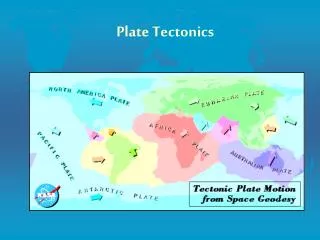
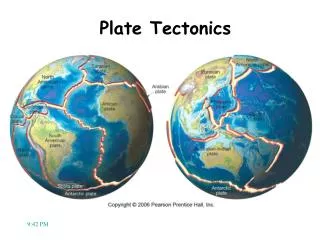
Divergent Plate Boundary – a plate boundary where two plates move away from one another Transform plate boundary - a plate boundary where two plates slide parallel to one another Convergent Plate Boundary - a plate boundary two plates move toward each other. Transform fault – a vertical surface of slipage between plates along an offset between two segments of a spreading ridge.
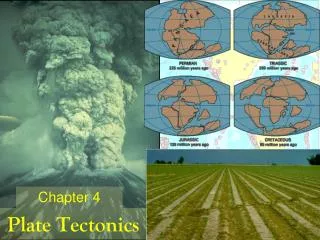
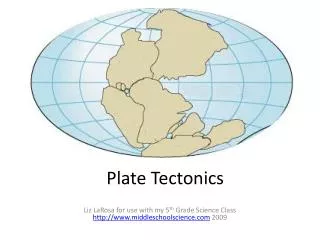
Density- mass per unit volume of material Thermal convection -pattern of movement in a fluid caused by heating form below and cooling from above. Thermal convection transfers heat energy from the bottom of the convection cell to the top. Plate tectonics- the field of study of plate motion. Continental accretion – the growth of a continent along its edges. Pangea - Earths most recent super continent which was rifted apart about 200 million years ago.
Supercontinent – a large continent consisting of all of the earths continental lithosphere. Supercontinents are assembled by plate tectonic processes of subduction and continent- continent collision Paleomagnetism – the record of the past orientation and polarity of the earths magnetic field recorded in rocks containing the minerals magnetite.