Download
1 / 10
100 likes | 189 Views
Explore r-process abundances at NSCL, Michigan State University. Models sensitive to astrophysical conditions, nuclear properties, beta-decay, neutron emission, and shell quenching. Detailed analysis of r-process production, Si PIN detector, BCS+NERO, and beta counting system. Neutron emission ratio observer with 60 counters for extensive neutron efficiency, and half-lives.

E N D
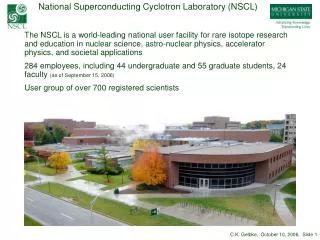
R-process experiments at the National Superconducting Cyclotron Laboratory Giuseppe Lorusso NSCL at Michigan State university
Models aimed to reproduce the observed r-process abundances are sensitive to: • astrophysical conditions • the nuclear properties of the neutron-rich nuclei involved in the process • Masses of nuclei near the drip line • -decay-properties • -decay-half lives • -delayed neutron emission probabilities
Effect of -delayed neutron emission probabilities Calculated r-process production of elements (Kratz et al. ApJ 403 (1993) 216): before b-decay after b-decay
Si PIN detector BCS+NERO SEGA Implantation set up
Particle Identification Transmitted species are identified according to their position in the particle-ID matrix with respect of nuclei of reference
Si Si Si b Beta Counting System • 4 cm x 4 cm active area • 1 mm thick • 40-strip pitch in x and y dimensions ->1600 pixels
Neutron Emission Ratio Observer Specifications: • 60 counters total (16 3He , 44 BF3) • 60 cm x 60 cm x 80 cm polyethylene block • Extensive exterior shielding • 45% total neutron efficiency