Download
1 / 7
70 likes | 176 Views
This project focuses on improving Java Modeling Language (JML) tool support by redeveloping the JML compiler (jmlc) to incorporate Java 1.5 features and ensure extensibility. The aim is to address the lack of robustness and ease maintenance overheads. The project investigates alternative architectures and proposes an incremental architecture for efficient compilation. Collaborative development with other JML developers is ongoing to enhance JML tools further.

E N D
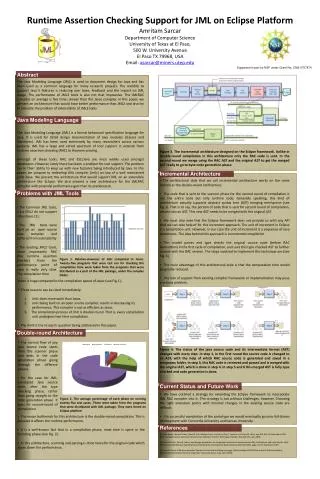
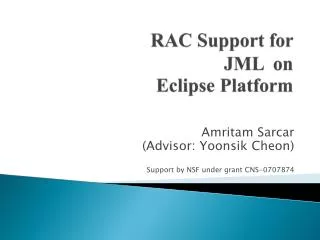
RAC Support for JML onEclipse Platform Amritam Sarcar (Advisor: Yoonsik Cheon) Support by NSF under grant CNS-0707874
Introduction • Java Modeling Language (JML) • Formal behavioral interface specification language for Java • Documentation of Java modules (classes and interfaces) • Spectrum of tool support • From runtime assertion checking (RAC) to theorem proving • RAC and ESC/Java most widely used
Problems with JML tools • Lack of robustness • Lack of extensibility • Not designed for it, e.g., code base for developing other tools • Maintenance overheads • Built upon a not-well-supported open-source Java compiler • No support for Java 1.5 features such as generics • Future changes in Java
Project Goal and Approach • Goal: To redevelop the JML compiler (jmlc) • Java 1.5 features such as generics • Future Java language changes, e.g., Java 1.8 and beyond • Code base for other JML tools • Approach • Develop a new compiler based on the Eclipse Java compiler • Design it with extensibility in mind
Accomplishments • Investigated several alternative architectures • Tool architectures: double-Round, incremental, bytecode weaving, and AspectJ-based • Bytecode architecture: inline, wrapper, and semi-wrapper • Proposed “incremental architecture” through analysis, comparison, and feasibility study (e.g., prototype)
Current and Future Work • Baseline architectural code for the incremental architecture • Full-blown development in collaboration with other JML developers at Kansas State and Concordia