
Measurement of Reflected Light in Seaweed Using HyperSAS for Accurate RRS Calculation
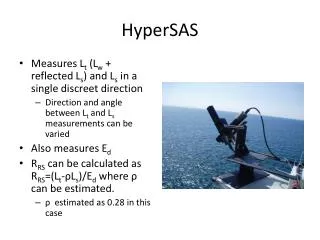
The HyperSAS system measures Lt and Ls in a single discreet direction, allowing for varied angles between these measurements. It also determines Ed, where the Relative Reflectance Spectrum (RRS) can be calculated as RRS = (Lt - ρLs) / Ed, with ρ estimated at 0.28 in this seaweed study. Group 2 tested the effect of pulled seaweed on measurements, revealing a distinct "red edge" reflectance due to intentional contamination. In contrast, Group 1 noted a potential seaweed effect on one reading, with minimal influence from accidental contamination in this case.

Measurement of Reflected Light in Seaweed Using HyperSAS for Accurate RRS Calculation
E N D
Presentation Transcript
HyperSAS • Measures Lt (Lw + reflected Ls) and Ls in a single discreet direction • Direction and angle between Lt and Ls measurements can be varied • Also measures Ed • RRS can be calculated as RRS=(Lt-ρLs)/Edwhere ρ can be estimated. • ρ estimated as 0.28 in this case
Seaweed in HyperSAS • Group 2 pulled seaweed in front of the HyperSAS to determine its effect on the measurement. • Intentional contamination showed a clear “red edge” reflectance • Group 1 thought it may have had seaweed contamination on one reading. • Little effect from accidental contamination in this case