Download
1 / 54
540 likes | 646 Views
This overview covers the essential functions and anatomy of the male and female reproductive systems. It highlights male reproductive functions such as gamete production and hormone secretion, detailing structures like the testes, epididymis, and prostate gland. For females, it discusses the ovaries, fallopian tubes, uterus, and vagina, as well as their roles in gamete production and nurturing offspring. Additionally, common disorders affecting reproductive health are summarized. Knowledge of these systems is crucial for understanding human reproduction and health.

E N D
Male Reproductive Functions • Produce gametes • Gametes are cells with 23 chromosomes – half the usual number • In males, the gametes are called spermatozoa • Transport gametes • Produce hormones
Structures • Testes (testicles) (Orch/i, orchid/o, test/o, testicul/o) • Manufacture spermatozoaand testosterone • Two small oval structures that develop in the abdomen and then descend into the scrotum • Scrotum • Sac that encloses and supports testicles outside of the body
Spermatogenesis • The creation of spermatozoa • Occurs in the seminiferous tubules of the testes • Will only occur at a temperature a few degrees below body temperature • This requires the testes to be located outside of the pelvic cavity
Structures • Epididymis (Epididym/o) • Comma-shaped coiled tube that runs down the length of each testis • Stores sperm as they mature and become motile • Vas Deferens (vas/o) • Ductus deferens • Carry sperm from the testes into the pelvic cavity where they join with the seminal vesicles
Structures • Seminal Vesicles • Two glands located at the base of the bladder • Secrete a thick, yellowish substance that nourishes the sperm cells • Join with the vas deferens to form the ejaculatory duct which connects to the urethra
Structures • Prostate Gland (Prostat/o) • Inferior to bladder surrounding the urethra • Walnut-sized • Secretes a thick alkaline fluid into the semen that aids the motility of the sperm • Motility means ability to move • Contributes to the expulsion of semen during ejaculation
Structures • Bulbourethral Glands • Located below the prostate gland • Secrete fluid that lubricates and neutralizes the urethra for the passage of semen • Urethra • Tube that carries semen (and urine) through the penis to the urethral meatus
Structures • Penis (Pen/o, phall/i) • Composed of spongy erectile tissue • Glans penis – sensitive region at the tip • Prepuce (foreskin) – fold of skin that covers the glans penis • Removed during circumcision
Medical Specialties • Urologist • Specializes in diagnosing and treating disorders of the urinary tract and male reproductive tract
Symptoms • Oligospermia • Producing semen with a low volume of sperm • Aspermia • Producing or ejaculating no semen • Azoospermia • Having no sperm in the semen • Impotence (Erectile Dysfunction) • Inability of an adult male to achieve an erection
Pathology • Cryptorchidism • Undescended testis • Benign Prostatic Hyperplasia (BPH) • Benign growth of cells in the prostate • Causes urinary retention and urinary hesitancy • Prostate Cancer • Malignant tumour of the prostate gland
Female Reproductive Functions • Producing gametes • Female gametes are known as ova • Nurturing developing offspring • Producing hormones
Structures • Ovaries (ovari/o, oophor/o) • Two almond sized organs, held in place on each side of the uterus by ligaments • Contain many ovarian follicles • Each follicle contains an ovum that matures and then is released when the follicle ruptures (ovulation)
Structures • Fallopian Tubes (Salping/o) • Oviducts • Carry the ovum from the ovary to the uterus • Approx. 4 cm long • The end near the ovary opens up into the funnel shaped infundibulumsurrounded by finger-like fimbriaewhich “catch” the ovum when itleaves the ovary • Fertilization most often occurs inthe fallopian tubes
Structures • Uterus (uter/o, hyster/o, metr/o) • Muscular organ that receives fertilized gametes and provides the environment for developing offspring • Pear-shaped– held in place by broad ligament • Normal position • Antiflexion (bent forward) • Located between the urinary bladder and the rectum • Area between the uterus and the rectum is known as the cul-de-sac
Structures • Parts of the Uterus • Fundus • Bulging, rounded part above the entrance to the fallopian tubes • Corpus • Body or middle portion • Cervix Uteri (cervic/o) • Lower portion that extends into the vagina
Structures • Tissues of the Uterus • Endometrium • Inner mucosal layer that is very rich in blood vessels • Myometrium • Muscular middle layer • Uterine Serosa (Perimetrium) • Outer lining that produces a watery secretion
Structures • Vagina (Vagin/o, colp/o) • Muscular tube lined with mucosa • Extends from cervix to outside of the body
Structures • External Genitalia • Collectively known as the vulva (vulv/o) • Located below the mons pubis – a pad of tissue located over the pubic symphysis • Labia Majora • Two large fat-filled folds of skin that enclose and protect the external genitalia and urethral meatus • Labia Minora • Smaller folds located medially to the Labia Majora
Bartholin Glands • Two small rounded glands on either side of the external vaginal opening • Produce mucous secretions that lubricate the vagina • Clitoris • Mass of sensitive erectile tissue located anterior to the urethral meatus
Structures • Perineum • Area between the vaginal opening and the anus • Hymen • Thin membrane that partially covers the entrance to the vagina
Structures • Breasts • Composed of mammary glands, fatty and fibrous tissue, and lactiferous ducts • Produces milk in response to hormones secreted after giving birth • Mammary Papilla • Nipple – has external openings for lactiferous ducts • Areola • Darkly pigmented area around the nipple
Menstruation • Menstruation • Normal periodic discharge of the endometrial lining and unfertilized egg from the uterus • Menarche • Onset of menstruation at puberty • Ovulation • Ovarian follicle ruptures and the ovum (egg) leaves the ovary
Menstruation • Estrogen • Produced by the ovarian follicle • Promote the development of female secondary sexual characteristics and repair of the endometrium • Progesterone • Secreted by the corpus luteum • Stimulates the build up of the endometrial lining • Premenstrual Syndrome (PMS) • Depression, breast tenderness and irritability that occur shortly before menstruation
Menopause • Ending of the menstrual cycle when ova are depleted and secretion of estrogen decreases • Symptoms: • Hot flashes • Insomnia • Vaginal atrophy
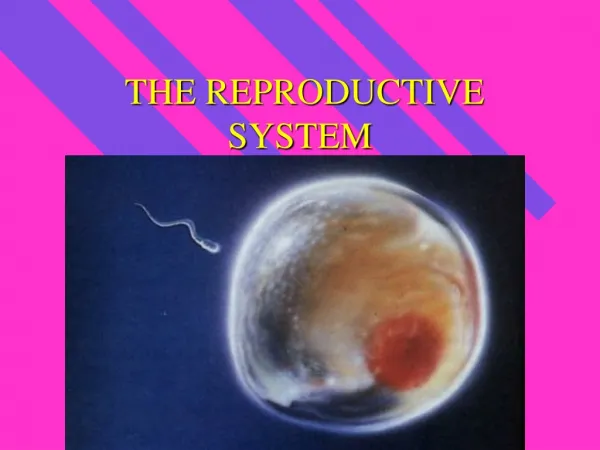
Gestation / Pregnancy • Fertilization • Occurs when a spermatozoon penetrates the ovum and releases its genetic material • The fertilized ovum is known as a zygote • Implantation • The zygote performs many cell divisions and then embeds into the endometrium
Gestation / Pregnancy • Embryo • The term for the developing offspring from the 2nd to 8th weeks of gestation • Fetus • The term for the developing offspring from the 8th week of gestation to the end of the pregnancy at approximately 40 weeks
Gestation / Pregnancy • Placenta • Organ that develops within the uterine wall • Connects to the fetus via the umbilical cord • Creates a barrier that keeps maternal and fetalblood separate, but allows the passage of nutrients, oxygen and wastes
Gestation / Pregnancy • Amnion and Chorion • Membranes that surround the developing embryo/fetus • Chorion – outer layer of the membrane • Amnion – inner layer that contains the amniotic fluid
Pregnancy • Antepartum • Final stage of pregnancy – just before onset of labour • Braxton-Hicks contractions – intermittent painless uterine contractions that may occur during the antepartum period
Parturition • Labourand childbirth • Occurs in three stages: • Dilatation – begins with contractions of the uterus and thinning and enlargement of the cervix (effacement), also involves rupture of the amniotic sac • Expulsion– uterine contractions become stronger and more frequent until the child is expelled through the birth canal • Crowning: the stage at which the head can be seen at the vaginal orifice • Expulsion of the placenta
Pregnancy • Terms referring to the Mother • -gravida means pregnant female • -para means a woman who has produced viable offspring • Nulligravida – woman who has never been pregnant • Primigravida – woman during her first pregnancy • Nullipara- woman who has never borne a viable child • Primipara – woman who has borne one viable child (Para I) • Multiparous – having borne one or more viable children (separate pregnancies)
Medical Specialties • Gynecologist • Specializes in diagnosing and treating disorders of the female reproductive system • Obstetrician • Specializes in providing medical care to women during pregnancy, childbirth, and afterwards • Neonatologist • Specializes in diagnosing and treating disorders of the newborn (neonate)
Symptoms • Amenorrhea • Absence of menses • Dysmenorrhea • Severe menstrual discomfort • Oligomenorrhea • Infrequent menstrual periods or very light flow
Symptoms • Menorrhagia • Abnormally heavy or long menstrual periods • Metrorrhagia • Bleeding between menstrual periods • Anovulation • Failure to ovulate
Pathology • Endometriosis • Occurs when endometrial tissue is found outside the ovaries • Causes inflammation and scar tissue, dysmenorrhea, pain, infertility and painful intercourse Tsaitgaist
Pathology • Fibroids • Benign tumours of fibrous tissue and muscle in the uterus • Leiomyomas • Symptoms: • Metrorrhagia • Pelvic pain • Menorrhagia
Pathology • Pelvic Inflammatory Disease (PID) • Inflammation and infection of the organs in the pelvic region • Commonly caused by STI’s • Scarring and adhesions can lead to infertility
Pathology • Ectopic Pregnancy • Implantation of the fertilized egg in a site other than the uterus • Preeclampsia • Abnormal condition in pregnancy • Symptoms: • Hypertension • Proteinuria • Edema • Headache
Sexually Transmitted Diseases • Sexually Transmitted Infections • Infections that are transmitted through sexual contact • Can also be passed to a baby during childbirth from an infected mother