Download
1 / 15
150 likes | 272 Views
Join Atanu Dey for an engaging exploration of economic development strategies, historical trends, and the role of policies in fostering growth. We will delve into the successes and challenges faced by various countries, including the dramatic rise of East Asia and the implications for Africa. Discussions will include the relationship between growth and poverty reduction, economic diversity, and the characteristics of developing nations. Participate in critical analysis of data and case studies to uncover the secrets behind effective economic policies.

E N D
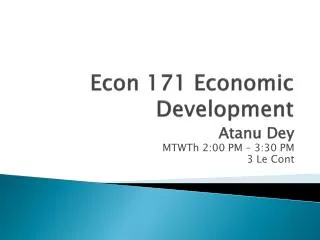
Econ 171 Economic Development Atanu Dey MTWTh 2:00 PM – 3:30 PM 3 Le Cont
Review • Discussions of the assignment • Questions Meeting 2 / N171 / Atanu Dey
Economic Policies • “Economic history is overwhelmingly a story of economies that failed to produce a set of economic rules of the game (with enforcement) that induce sustained economic growth.” -- Douglass North, Nobel Laureate • Policies matter Politics matter Meeting 2 / N171 / Atanu Dey
Extremes of the Global Economy • Gunnar Myrdal Swedish Nobel Laureate economist said 50 years ago that Asia will be mired in poverty • Asia was already taking off. • 50 years of successes in East Asia • China is the A-class students of American economics • In just 15 years, more than 450 million Chinese got out of poverty between 1990 and 2005 • Africa population with less than $1.25 per day went from <300 to 388 million in 2005 • MDG of poverty reduction will not be achieved Meeting 2 / N171 / Atanu Dey
What’s the Secret • What accounts for the successful? • Botswana is very successful cases. Why? • Data exists in huge piles. But making right inferences is hard. • Growth is necessary but not sufficient for long term poverty reduction • US median income 2009 is lower than it was in 1997. • GDP has increased, GDP per capita has increased • People in the middle and bottom are not doing well. Meeting 2 / N171 / Atanu Dey
Growth & Development • They are distinct • Growth is necessary but not sufficient for poverty reduction • How to get growth • How are the benefits of growth to be shared • 50 years ago it was shortage of capital for poor countries – The World Bank • The WB failed to make the promised difference • The focus was to change to policies Meeting 2 / N171 / Atanu Dey
Economic Diversity • Output per US worker 10 times that of a worker in India, and 50 times that of a worker in Congo • Real income per capita • US: $48k, India: $3K, Congo: $280 • World Bank defines • Low-income countries < $975 (2008 $) • Lower-middle > $976 < $3855 • Upper-middle > $3856 < $11,906 • High-income > $11,907 Meeting 2 / N171 / Atanu Dey
Is Saudi Arabia a Developing Country? • What is a developing country? • Emerging markets? • Newly industrialized countries Meeting 2 / N171 / Atanu Dey
Development Indicators • Real income: per capita adjusted for purchasing power (Measure of the standard of living) • Health: life expectancy at birth, child mortality and undernourishment • Education by literacy and years of schooling • Human Development Index of the UNDP • See the Human Development Reports • http://hdr.undp.org/en/statistics/ • Play around here http://hdr.undp.org/en/data/trends/ to see the trends Meeting 2 / N171 / Atanu Dey
Developing World Characteristics • Lower levels of productivity and living • Lower levels of human capital (health, education, skills) • Higher levels of inequality and absolute poverty • 20% of the poorest people globally receive on 1.5% of the world income (1.4 billion people) • Living on less than $1.25 income per day • What would it require to bring everyone above this poverty line? Meeting 2 / N171 / Atanu Dey
Extremes of income & wealth • About 2% of the income of the richest 10% • Scale of global inequality is unfathomable • Even within countries, there are extremes of wealth Meeting 2 / N171 / Atanu Dey
Developing World Characteristics (contd) • Higher population growth rates • 1800 CE: < 1 billion • 1900 CE: 1.65 billion • 2000 CE: 6 billion • Late 2011: 7 billion • Large rural populations and rapid rural-urban migration • Lower levels of industrialization and manufactured exports • Adverse geography • Tropical or semi-tropical Meeting 2 / N171 / Atanu Dey
Developing World Characteristics (contd) • Underdeveloped markets • Lingering colonial impacts • Extractive and exploitative policies • Not development oriented Meeting 2 / N171 / Atanu Dey
Differences between low-income today and in the past • Physical and Human Resource Endowments • Relative Levels of Per Capita Income and GDP • Climatic differences • Population size, distribution and growth • The role of International Migration • 60 million migrated to the Americas between 1850 and 1914 (world population was a fourth of today’s) • Brain drain? • Free trade Meeting 2 / N171 / Atanu Dey
Convergence? • Next time Meeting 2 / N171 / Atanu Dey