Legal Considerations in Admissibility of Evidence and Defendant's Statements
50 likes | 165 Views
This content delves into critical legal doctrines related to the admissibility of evidence, particularly focusing on the Fourth Amendment's implications, the best evidence rule, and various hearsay exceptions. It examines the nuances of authentication, including witness testimony, voice identification, and the significance of a defendant's statements. Key concepts such as co-conspirator statements, past recollection, and impeachment by conviction are explored while addressing how courts determine relevancy and admissibility in trial settings. These principles are essential for legal professionals navigating complex criminal cases.


Legal Considerations in Admissibility of Evidence and Defendant's Statements
E N D
Presentation Transcript
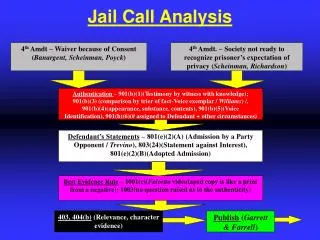
4th Amdt – Waiver because of Consent (Banargent, Scheinman, Poyck) 4th Amdt. – Society not ready to recognize prisoner’s expectation of privacy (Scheinman, Richardson) Authentication – 901(b)(1)(Testimony by witness with knowledge); 901(b)(3) (comparison by trier of fact-Voice exemplar / Williams) /, 901(b)(4)(appearance, substance, contents), 901(b)(5)(Voice Identification), 901(b)(6)(# assigned to Defendant + other circumstances) Defendant’s Statements – 801(e)(2)(A) (Admission by a Party Opponent / Trevino), 803(24)(Statement against Interest), 801(e)(2)(B)(Adopted Admission) Best Evidence Rule – 1001(c)(Falcetta videotaped copy is like a print from a negative); 1003(no question raised as to the authenticity) 403, 404(b) (Relevance, character evidence) Publish (Garrett & Farrell) Jail Call Analysis
104(a) – Preliminary questions of admissibility shall be determined by the court. 104(b) – When relevancy depends on a fact, the court shall admit it upon or subject to the introduction sufficient to support a finding of the fulfillment of that fact Authentication –901(b)(4)(appearance, substance, contents / Druery); 901(b)(1)(Testimony by witness with knowledge); 901(b)(2)(Non-expert opinion on handwriting) Defendant’s Statements – 801(e)(2)(A) (Admission by a Party Opponent / Trevino), 803(24)(Statement against Interest / Wood) Best Evidence Rule – 1004 – original held by opponent (“…original is mailed as usual…”) Druery: Do these distinctive characteristics (901(b)(4)) satisfy the court (104(a)) that a reasonable juror could conclude (104(b)) that the letter was authored by the defendant (i.e., what the proponent says (901(a)) Mail Analysis
801(e)(2)(E) – intent to induce another to deal with co-conspirators, future strategies, identifying roles (Byrd) 803(24) – So far subjecting the speaker to criminal liability that a reasonable person wouldn’t say it unless it was true (Wood) YES Don’t worry about Crawford Will the Co-∆ Testify? NO YES Testimonial? (Woods, Crawford)Statements between co-conspirator during the conspiracy are not testimonial. Can’t Admit NO 403, 404(b) (Relevance, character evidence) 608: truthful character if it’s been attacked 609: Impeachment by Conviction 806 – Impeach Declarant’s Credibility 613(a): Prior Inconsistent Statement 613(b): Examining Bias or Interest Co-Defendant Statement Analysis Beware Rehabilitation! 405(a), prior consistent stmt.,
803(4): Medical Diagnosis (Garcia); 803(1): Present Sense Impression (Fischer) reflexive product 803(2):Excited utterance, time for reflection (Apolinar); 803(3) Dying Declaration (Thomas) – impending death YES Yes – don’t worry about Crawford Will the Declarant Testify? NO Giles: Only 1) Dying Declaration or 2) Forfeiture by Wrong-doing: intent to prevent YES Testimonial? (Vinson)To a cop: Would a reasonable person appreciate the fact that the police officer was collecting information for prosecution? To a non-cop (Woods) Casual Acquaintances Doctrine. NO 403, 404(b) (Relevance, character evidence) 608: truthful character if it’s been attacked 609: Impeachment by Conviction 806 – Impeach Declarant’s Credibility 613(a): Prior Inconsistent Statement 613(b): Examining Bias or Interest Hearsay Analysis Beware Rehabilitation! 405(a), prior consistent stmt.,
612: Writing Used to Refresh Memory: wirtings looked at by witnesses either while or before testifying shall be given to the other side. Will this refresh your memory? • 803(5): Past Recollection Recorded: • W once had knowledge; • W made writing at or near the time • W can’t remember now • W now vouches for accuracy • (Johnson) • 613(a): Prior Inconsistent Statement: • Substance, • time, place, and person, • opportunity to explain. • **Extrinsic evidence admissible if and only if person denies making statement** 801(e)(1)(B): Prior Consistent Statement: offered to rebut an express or implied charge of recent fabrication or improper influence. Hammons: would a reasonable judge, considering all phases of trial, and demeanor of cross examiner, conclude the W has been challenged for Recent Fabrication or improper influence Writings Review