Static Electricity
430 likes | 448 Views
This informative piece explores the occurrence of static electricity, debunking common misconceptions about energy types and atomic charges. Learn about static electricity phenomena through engaging illustrations and explanations.


Static Electricity
E N D
Presentation Transcript
Static Electricity By: Brianna Shields April 27, 2005
DO NOW • 1. Which of the 5 main types of energy is released when food is digested? • 2. A child seated at the top of a slide has what type of energy (kinetic or potential)? • 3. Speaking to a crowd requires which of the 5 main types of energy?
GOAL • To explain the occurrence of static electricity
Review: Find the fiction • Electromagnetic energy is the movement of electrical charges • Chemical energy is the splitting of the atom’s nucleus • Heat energy is warmth created when particles rub quickly together
Review: Find the fiction • Electromagnetic energy is the movement of electrical charges • Chemical energy is the splitting of the atom’s nucleus- FALSE • Heat energy is warmth created when particles rub quickly together
Review: Find the fiction • Chemical energy is the breaking and releasing of bonds between atoms • Electromagnetic energy is the movement of proton particles • Nuclear energy is created by the splitting of an atom’s nucleus
Review: Find the fiction • Chemical energy is the breaking and releasing of bonds between atoms • Electromagnetic energy is the movement of proton particles- FALSE • Nuclear energy is created by the splitting of an atom’s nucleus
Review: Find the fiction • Sound is a type of electromagnetic energy • Light is a type of electromagnetic energy • X rays are a type of electromagnetic energy
Review: Find the fiction • Sound is a type of electromagnetic energy- FALSE • Light is a type of electromagnetic energy • X rays are a type of electromagnetic energy
Review: Find the fiction • Digestion is a type of chemical energy • Rainbows are a type of mechanical energy • Sound is a type of mechanical energy
Review: Find the fiction • Digestion is a type of chemical energy • Rainbows are a type of mechanical energy- FALSE • Sound is a type of mechanical energy
Review: Find the fiction • Chemical energy creates warmth when particles rub together quickly • Mechanical energy is used by moving objects • Electromagnetic energy involves the movement of negative electrons
Review: Find the fiction • Chemical energy creates warmth when particles rub together quickly- FALSE • Mechanical energy is used by moving objects • Electromagnetic energy involves the movement of negative electrons
Review: Find the fiction • Photosynthesis involves chemical energy • Digestion involves chemical energy • Sound involves chemical energy
Review: Find the fiction • Photosynthesis involves chemical energy • Digestion involves chemical energy • Sound involves chemical energy- FALSE
Review: Find the fiction • Rubbing your hands together involves both mechanical and heat energy • Using a blow dryer involves both electromagnetic and heat energy • Listening to the radio involves both electromagnetic and chemical energy
Review: Find the fiction • Rubbing your hands together involves both mechanical and heat energy • Using a blow dryer involves both electromagnetic and heat energy • Listening to the radio involves both electromagnetic and chemical energy- FALSE
Proton Neutron Electron Positive (P+) Found in the nucleus Neutral (N) Found in the nucleus Negative (e-) Found zipping around outside the nucleus Atom Review
How do atoms become charged? • Draw a sketch of 2 atoms being rubbed together- how do they become charged????
Charged atoms Extra electrons = negatively charged object/atom Missing electrons = positively charged object/atom Atom Review
Subatomic Particle Rules Opposite charges attract Proton-electron Like charges repel Electron-electron Proton-proton Atom Review
Static Electricity The accumulation of extra negative electrical charges on an object Only electrons are transferred (not protons) Atom Review
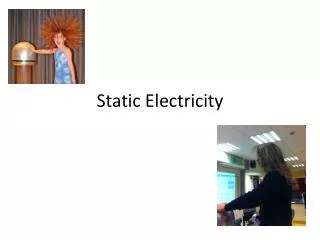
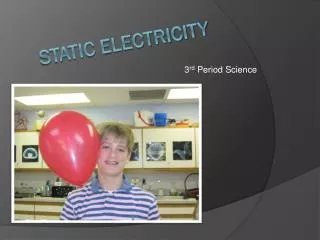
Static Electricity Video Questions • Explain why your hair becomes attracted to a balloon once it’s been rubbed on your head
For each of the following static electricity examples you must do the following: • 1. Draw a picture • 2. Accompany it with an explanation
Scenario 1: If you shuffle your feet on the carpet, then reach out to touch a metal door knob, you receive a shock by a spark • Rubbing disturbs the atoms • Electrons rubbed off carpet and onto your feet • Shoe has extra e’s (negative chg) • Rug is missing e’s (positive chg) • Extra electrons from the shoe are transferred to the doorknob in the form of an electrical spark
Scenario 2: Clothing sometimes clings together upon removal from the dryer- Why? • Electrons rub off clothes and stick to others • Some items get a negative charge • These clothes are attracted to the ones with a positive charge (clothes missing electrons).
Scenario 3: Charging by Induction- charged object and neutral object attract when atoms in neutral object rearrange their protons and electrons • Rub a balloon w/ a cloth to charge it, it accumulates extra negatives on it • Bring it close to a wall and it rearranges the atoms on the wall • It pulls protons closer and pushing electrons away
Scenario 4: Bending Water • Charge the rod, bring it close to water • It rearranges the electrons in the water causing the protons to be attracted to the negative rod
Scenario 5: A shocking experience • Rub the balloon on a wool shirt • Bring the balloon near you hair and it attracts the hair • The electrons on the balloon attract the protons in the hair through charging by induction
Scenario 6: Pumping Gas • Rubbing against car upholstery, talking on the cell phone can generate static electricity • If the electrons are not discharged by touching a non-hazardous metal object (like a car door) they may be a potential fire risk while pumping gas
Scenario 7: Bandaids and Certs • Plastic Cur-aid bandaids will “spark” when you rip the white tabs off quickly as electrons are stripped and transferred • Snapping or quickly biting into wintergreen or peppermint certs mints can cause a spark of electrons
Scenario 8: Van de Graff Generator • This apparatus generates electrons as the belt spins • Electrons are free to pass through the metal sphere • It is grounded with a metal wand protected by a plastic handle, hooked into the faucet • Anyone touching the generator also gathers electrons, when you remove your hands you get a big shock
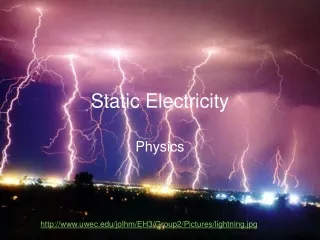
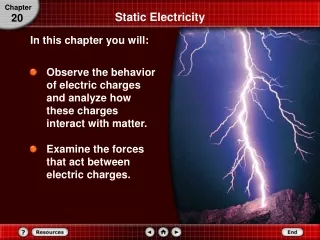
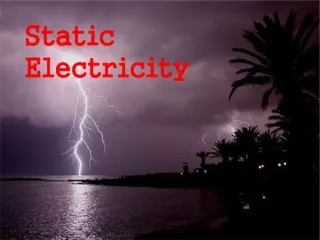
Scenario 9: Lightning • The accumulation of negative charge in clouds • Electrons transfer to positively charged ground to even out the charge • Produces electrical spark known as lightning
Conductor Allows electricity (electrons) to easily pass through it Ex: Metals Atom Review
Insulator Provides resistance to electron flow (blocks it or slows it down) Ex: rubber, wood, plastic, glass Atom Review