Understanding Error Handling and Memory Management in C++: Assertions and Exceptions
This document explores C++ error handling techniques, focusing on assertions and exceptions. It discusses the use of assertions for error checking, noting limitations such as only functioning in Debug mode and causing program exits. It contrasts assertions with structured exception handling, detailing how exceptions must be enabled, how errors are detected and thrown, and how they are caught. The document covers the standard exception hierarchy, predefined exceptions, and rules for effective exception management in C++, providing a comprehensive guide for developers.

Understanding Error Handling and Memory Management in C++: Assertions and Exceptions
E N D
Presentation Transcript
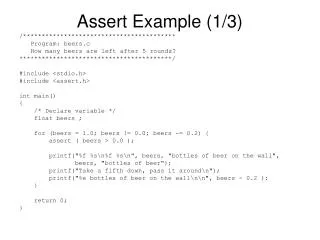
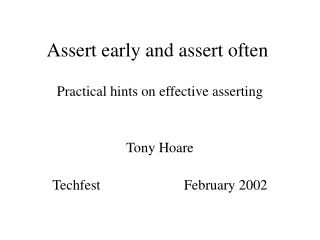
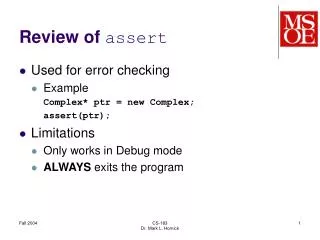
Review of assert • Used for error checking • Example Complex* ptr = new Complex; assert(ptr); • Limitations • Only works in Debug mode • ALWAYS exits the program CS-183Dr. Mark L. Hornick
Similar Error Handler Complex* ptr = new Complex; if (!ptr) { cerr << “Allocate failed”; exit(EXIT_FAILURE); } • Other solutions • Substitute a safe alternative • e.g. A file open fails, use a default name CS-183Dr. Mark L. Hornick
Exceptions • C++’s structured solution to error handling • Java’s is almost identical • Basic mechanism • exception handling must be enabled in project properties • This is enabled by default • Code detects an error – throws an exception • Special code catches the throw CS-183Dr. Mark L. Hornick
Linked by thrown type! Exception Example void GetData(…,const string& file) { ifstream infile(file.c_str()); try { if (ifstream) { // Normal file I/O } else throw(file); } … catch(string str) { cerr << … } } CS-183Dr. Mark L. Hornick
Coding Exceptions • try • Look for exception in code block • throw • Exception found, providing data • catch • Handle exception based on type • Flexible • The function throwing doesn’t have to be the one that catches • Can be many levels up in the call stack CS-183Dr. Mark L. Hornick
Rules for Exceptions (1) • Lowest level will make the catch • If the types match • If no catch is found at any level • That matches the type • Program exits with error CS-183Dr. Mark L. Hornick
Rules for Exceptions (2) • A generic or default catch is possible • Ellipses (…) catches any type catch(…) { statements… } • Often used for cleanup • delete memory locally newed • (Destructors still called, though) • Re-throw to give caller chance to handle after local cleanup… • throw; CS-183Dr. Mark L. Hornick
Catching Allocation Errors • Without exception handling Complex* ptr = new (nothrow) Complex; • With exception handling try { … Complex* ptr = new Complex; } catch (bad_alloc b) { statements… } CS-183Dr. Mark L. Hornick
Standard Exception Hierarchy • Most thrown types are derived • From base class: exception • Found in #include <exception> CS-183Dr. Mark L. Hornick
Predefined Exceptions • <stdexcept> • runtime_error • e.g. overflow_error, underflow_error • logic_error • e.g. invalid_argument, length_error, out_of_range • Others • bad_alloc, bad_typeid, bad_exception CS-183Dr. Mark L. Hornick