Download
1 / 115
1.17k likes | 1.29k Views
This session discusses a multidisciplinary approach to evaluating and managing a 45-year-old male patient with HBV-related cirrhosis and a 4cm lesion in the right lobe indicative of hepatocellular carcinoma (HCC). Panelists include experts in radiology and hepatology who outline the importance of imaging modalities like MDCT and MRI for diagnosis and staging, as well as considerations for biopsy. The discussion covers treatment options such as surgical resection and liver transplantation, highlighting scoring systems for liver function and their implications for therapy decisions in HCC patients.

E N D
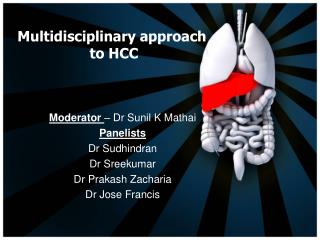
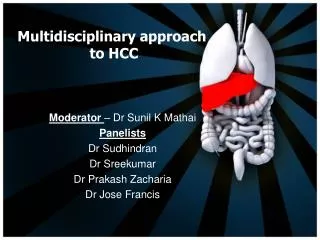
Multidisciplinary approach to HCC Moderator – Dr Sunil K Mathai Panelists Dr Sudhindran Dr Sreekumar Dr Prakash Zacharia Dr Jose Francis
Case -1 • 45 year male who is known case of HBV related Cirrhosis on entacavir is found to have a 4cm lesion in right lobe seument 6.
4 cm lesion in HBV related Cirrhotic liver • Further Imaging • 4Phase MDCT / MRI • Diagnosis - Typical Characters of HCC • Multifocal or not • Vascular involvement • Nodes • Status of Liver & virus • General Condition of patient
Imaging modalities in HCC – Dr SM • CT/MRI in HCC • Kupffer specific imaging
Imaging in HCC • Contrast Enhanced 4 phase MDCT • Contrast MRI • Contrast USG
Would you biopsy the lesion– Dr Jose • Indications for biopsy in suspected HCC
Why? • If curative therapeutic attempts are planned, including surgery - Biopsy is often contraindicated Stigliano R et al Cancer Treat, Rev.2007; 33:437-447 • Avoid the risk of seeding (2.7%) Perkins JD et al L. Hepatol. 1999;30: 472-478 JF
Why? • Likelihood of HCC is > 90% - If AFP is > 200 ng/ml - Setting of a mass in a cirrhotic liver Torzilli G et al Hepatology1999;30: 889-893 JF
Why? • Diagnosis confidently established - Presence of typical imaging features • Four-phase multidetector CT (the four phases) - Unenhanced, - Arterial, hyperattenuating - Venous, and hypoattenuating (washout) - Delayed • Dynamic contrast-enhanced MRI JF
Algorithm JF
Case continued …. • Investigation were s/o HCC
How will you stage the lesion – Dr PZ Overview of staging systems
Investigations • Liver lesion - assessment • Child Status • Portal Hypertension • Platelet count (<1lakh) with splenomegaly • OGD for varices, If no varices -?HVPG • Evidence of dissemination • Assessment of patient • Other medical conditions • Performance Status
How will you assess the functional liver reserve – Dr Jose • Scoring systems ( MELD,CTP ) versus Role of HVPG Role of ICG
Hepatic functional reserve • Related to - Quantity - Quality of liver cells • Assessment of remaining liver prior to hepatectomy JF
Assess functional liver reserve • MELD score • ICG Clearance • CT measurement of liver volume • Others - HVPG JF
MELD and HCC • Increase priority of patients for Tx with HCC - Assigned a higher score based on tumour staging • Risk for ‘dropping out’ from the list because of cancer progression JF
MELD and HCC • T2 lesion - 15% risk, score of 22 • 10% mortality bonus every 3 months - Until they are Tx or - No longer suitable for Tx JF
Role of ICG • Qin-Song Sheng, • Hepatobiliary Pancreat Dis Int,Vol 8,No 1 • February 15,2009 • ICG-R15 (N= 3.5% to 10.6% ) • >14% precludes major liver resection
Role of HVPG • MELD scores has been correlated with manifestations of liver disease such as hepatic venous pressure gradiennts • Ripoll C et al Hepatology 2005;42(4);793-801 • Portal hypertension - Independent factor in post-resection outcome - Patients with Child–Pugh class A cirrhosis and minimal portal hypertension - Platelet count >100,000/mm3 and/or - HVPG <10 mmHg) - Are optimum resection candidates JF
CTMeasurement of the liver volume • The percentage of RLV (PRLV) was calculated using the following formula: • PRLV=RLV/predicted total liver volume ×100% • RLV = Total liver tumor - (tumor volume + peri-tumor volume) • The predicted total liver volume (mL) = 121.75 + 16.49 × body mass (kg) JF
Case continued…. • 4cm HCC. Child A CTP- 6/15 MELD- 8. No PV thrombus.
What treatment would you advise here here – Dr Sudhi • Resection v/s Transplant • Indications for resection • Indications of transplant. • Expanding indications for resection • Expanding indications for transplant • Cytoreductive and salvage surgery
Treatment of HCC • Main issues • Survival • Recurrence
HCC- resection • Mainstay of treatment • No Level I evidence • Compelling data from cohort studies • Ideal candidates • Single nodule • Less than 5 cms • No vascular invasion • Contraindication: • Distant metastasis • Main portal vein thrombus • IVC thrombus • Results • 5 yr survival 35 to 70% • Recurrence: 50 to 80%
Transplantation • Theoretically the “best”: • Widest possible resection margin • Removes remnant liver at risk of cancer • Restores liver function • Advanced tumours • High risk of recurrence • Milan criteria • 5 cm • 3 cm (X3) • UCSF • 6.5 cms • 4.5 cm (X3) Upto 7 Largest tumour plus number equals 7 No vascular invasion AFP
Results of transplantation • 5 year survival 60 to 75% • 5 year recurrence rate 30 to 40% • No trial between resection and Tx • If donor (LDLT or DDLT) available, Tx
Suppose you plan for transplant. Would you advise a LDLT ? Dr PZ • Ethics of LDLT in HCC patients
LDLT advantage • LDLT – No or minimal waiting period
Issues • Hep B • Risk to the donor • Adverse tumor factors • Pressure to Expand the criteria (?)
Would you consider RFA/TACE/TARE here. Dr SM • Indications and clinical outcome of RFA • Indications and clinical outcome of TACE/TARE • RFA versus resection/Transplant • RFA versus TACE/TARE
4cm HCC,Child A • – RFA or TACE with RFA
Ablative therapy • RFA/PEI • Visiblity on USG or plain CT • If visible, relationship with adjacent viscera and vessels
Ablative therapy indications • Child Pugh A or B • Single </= 3cm or 5cm • Multiple nodules </= 3 in number each </= 3cm
Ablative therapy • PEI and RFA complete response in 80% <3 cm • complete response in 50% 3-5cm • 40-70% 5 yr survival which is little less than resection
TACE • Care for Intermediate stage • Child A or B • Single ≥ 5cm and ≤ 8 cm • Multiple more than 3 • LESIONS WHICH ARE IDEAL FOR ABLATION BUT WITH POOR VISBILTY ON USG /CT
TACE • Contra indications • Portal vein thrombosis • Portal flow reversal • Child C cirrhosis
TACE • Partial response in 15-55% • Significantly delays tumour progression • Llovet etal*-Meta analysis • 2yr survival in treated group 41% vs 27% in control group • Llovet JM, Bruix J. Systematic review of randomized trials for unresectable hepatocellular carcinoma: hemoembolization improves survival. Hepatology 2003;37:429–42
TACE • Doxorubicin.Mitomycin C,cisplatin • Conventional TACE with lipiodol • TACE with DEB(DC Beads)