Constitutional Underpinnings
Explore the foundational elements of the United States Constitution, examining the weaknesses of the Articles of Confederation that led to its creation. This overview includes key events like Shay's Rebellion, debates at the Constitutional Convention, and the establishment of a stronger central government. Delve into the theories of prominent Enlightenment philosophers and the intricacies of federalism, separation of powers, and checks and balances that shape American governance today. Learn about significant constitutional clauses, landmark court cases, and the advantages and disadvantages of federalism in modern policy-making.

Constitutional Underpinnings
E N D
Presentation Transcript
Constitutional Underpinnings By: Lillian Chang, Priya Sharma, Kathy Wang, and Amanda Phan
The Articles of Confederation • The federal government was weak • Shay’s Rebellion exposed the weaknesses of the government • Nation’s leaders called for a stronger central government
Weaknesses of the Federal Government • Could not draft soldiers • Could not tax citizens- tax revenue was dependent on state policies • Not able to control interstate trade • No national currency • Needed approval from 9 out of 13 states to pass laws • Needed unanimity to amend Articles
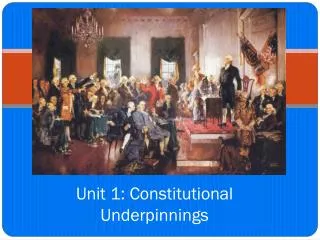
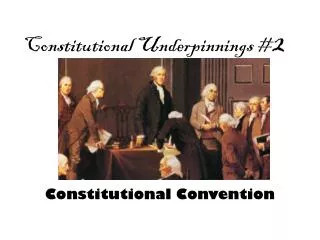
The Constitutional Convention • The Framers met in Philadelphia 1787 • Stronger Central government was needed • Virginia Plan vs. New Jersey Plan
The Great Compromise • Bicameral Legislature: • House of Representatives • Senate • Representation of Slaves • Three Fifth Compromise
The Constitution • A blueprint and guide for the structure of government • Is vague purposely • The elastic clause allows Congress to “make all laws” that appear “necessary and proper” • Executive orders and agreements • Judicial Review
Enlightenment Philosophers • Thomas Hobbes • Best way to protect life was to give power to an absolute monarch • John Locke • Life, liberty and property were natural rights • Duty of the government to protect rights • Charles de Montesquieu • Three branches of government • Jean Jacques Rousseau • Social Contract
Government • Institution that creates and conducts public policy • Maintains legitimate authority and control over society
Policymaking System • Linkage institutions – serve to set political agenda • Media • Political parties • Interest groups • Polls
Elitist Theory • A small number of powerful elite form an upper class, which rules in its own self-interest.
Pluralist Theory • Interest groups compete with each other for power and control over public policy • No group or set of groups dominates • Bargaining and compromise are essential to democracy
Hyperpluralist Theory • Too many influential groups in democracy • Government is often “pulled” in many directions at the same time • Causes gridlock and ineffectiveness
Separation of Powers • power is separated between branches of government • each branch has its own powers and duties and is independent of and equal to the other branches
Checks and Balances • Each branch is subject to restraints by the other two branches
Legislative Branch • Congress (Senate and House of Representatives) • passes laws • Bicameral Legislature • Has checks over Executive Branch • Has checks over Judicial Branch
Executive Branch • President, Cabinet, White House Staff • enforces laws • Has checks over Judicial Branch • Has checks over Legislative Branch
Judiciary Branch • Supreme Court, lower courts • interprets laws • Has checks over Legislative Branch • Has checks over Executive Branch
Constitutional Clauses • These clauses show the dominance of the national government over the states. • Supremacy Clause • Necessary and Proper Clause • Commerce Clause
Court-Cases • McCulloch vs. Maryland • Gibbons vs. Odgen • These court cases deal with the issues of Federalism
Powers granted to states • Tenth Amendment: any powers not directly stated in the Constitution are reserved to the states. From using the tenth amendment states can: • Establish public schools • Protect health and safety (police and fire) • Regulating business • Marriage laws
Federal and State Powers • Concurrent power: ‘shared powers’ are levying and collecting taxes, creating courts, borrowing money, and having private property for public use. • Interstate compact: states can form relationships with each other, like how the federal government has treaties with other countries
Interstate relations • Full Faith and Credit Clause • Extradition • Privileges and Immunities Clause
Types of Federalism • Dual federalism: layer-cake federalism • Cooperative federalism: marble-cake federalism • Centralized federalism
Categorical Grants • Money provided by the federal government to the state and local governments • Have a specific purpose defined by law • Project grants • Formula grants
Block Grants • General • Can be used for a variety of purposes within a broad category • Preferred by states over categorical grants
Mandates • Requirements imposed by the federal government on the state and local governments • American with Disabilities Act (1990) • Often no federal funding (unfunded mandates)
Advantages of Federalism • Increases possibilities of political participation or greater access to the political process • Innovation to handle policy questions • Gives interest groups a strong political voice • Encourages diversity on many policy questions
Disadvantages of Federalism • Fragmentation of politics, because of the many levels of agencies which make the process too complicated. • Basic inequity in the federal system • Strong state and local groups can obstruct and delay putting in national policy
Thanks for watching our presentation! • Any questions???