Fast Simulation of Lightning for 3D Games
This project presents a fast simulation algorithm for realistic cloud-to-ground lightning strikes in 3D games, focusing on real-time performance and aesthetic quality. Utilizing Cellular Automata, we simulate lightning behavior, including stepped leaders and return strokes. The design includes complex algorithms for generating lightning branches and evaluating electrical fields based on atmospheric properties. Results demonstrate visually appealing lightning effects tailored for immersive gameplay with minimal lag, paving the way for future enhancements, including support for light sources and improved branch modeling.
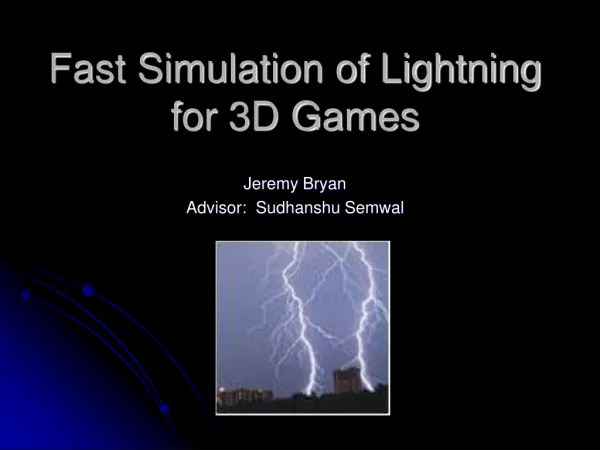

Fast Simulation of Lightning for 3D Games
E N D
Presentation Transcript
Fast Simulation of Lightning for 3D Games Jeremy Bryan Advisor: Sudhanshu Semwal
Overview • Introduction • Applications • Previous Research • Design • Implementation • Results • Future Work • Conclusion
Introduction • Realistic cloud-to-ground lightning strike • 3D game emphasis • Real-time requirement • Cellular Automata implementation
Introduction (cont.) • Lightning Basics • Strong electrical field • Stepped leader • Upward positive leader • Attachment process • Return stroke
Applications • 3D Games • Movies • Physical modeling • ???
Previous Research • Reed • “Visual Simulation of Lightning” • Emphasis on rendering with ray-tracing • Simple 3D model generation
Previous Research (cont.) • Dobashi • Identical modeling technique as Reed • Takes scattering effect due to atmospheric particles and clouds into account
Previous Research (cont.) • UCCS Physics website r is a generated random number that represents atmospheric properties. E is the electric field and can be found by using Maxwell’s Equations. α controls the weight of E on r. • Find largest breakdown number (X) • X=Eαr
Cellular Automata • Discreet lattice • Discreet time-steps drive simulation • Each cell has finite set of values • Each cell evolves according to same set of rules • Evolution of cell depends only upon local neighborhood interaction
Design • Complex Lightning Algorithm • Ground up • Assign values on the fly • Random numbers for “r” • Make the calculations • Find largest breakdown number (X) • X=Eαr • Segment length
Design (cont.) • Pseudocode Proc GenerateComplexLightning // Load the starting coordinates list.add target.coords while height <= MAX_ALTITUDE Assign r to 26 neighbor cells if they do not have one Calculate E for 26 neighbor cells if not done previously Find maximum X list.add maxE.coords end while for each voxel in list temp = rand() if temp < BRANCH_PROBABILITY then GenerateComplexBranch() end if end for end proc
Design (cont.) • Complex Branch Algorithm • Parent iteration • Uniformly distributed probability function • Recursive • Random branch length
Design (cont.) • Pseudocode Proc GenerateComplexBranch BranchLength = rand() while (BranchHeight >= 0 And BranchLength >=0) Assign r to neighbor cells if they do not have one Calculate E for cells if not done previously Find maximum X BranchList.add maxE.coords end while for each coord in BranchList.coords if (rand() < BRANCH_PROBABILITY) then GenerateComplexBranch() end if end for end proc
Implementation • Object-Oriented Design • Programming Languages • Supporting packages • HeightMap Tutorial • Linked list library • OpenGL car tutorial
Implementation (cont.) • Development model • Class structures • CCamera • CVoxel • Lightning • Camera • Target • Car • Explosion
Implementation (cont.) • Observations • Run-time dependent on max branch depth and probability of branching • Large branch clusters detract from final product and are time intensive • Number of voxels in a given dimension match map size. Increasing resolution would not enhance results.
Results (cont.) • Survey
Results (cont.) Sample Size = 64
Future Work • Efficiency • Support for light sources • Branch modeling • Control point support • ???
Conclusion • Aesthetically pleasing results • No discernable lag-time • 3D game environment