Understanding Sentence Complements: Subjects, Verbs, and Complements Explained
This resource provides an in-depth exploration of sentence complements, which complete the meaning initiated by the subject and verb. It clarifies the definition of complements, including subject complements (predicate nominatives and predicate adjectives), and differentiates them from prepositional phrases. Various examples illustrate how complements enhance sentence meaning. With essential practice activities, learners can identify subjects, verbs, and complements, deepening their understanding of sentence structure and grammar.


Understanding Sentence Complements: Subjects, Verbs, and Complements Explained
E N D
Presentation Transcript
All sentences have a base • Subject+verb=base • Ex: Owlshooted • The ballerina in white was leaping. • Christy, the first chair violinist, plays beautifully. • Frequently, the sentence base will not only have a subject and verb, but also a completer, or complement. Day 1
A Complement completes the meaning begun by the subject and verb. • A COMPLEMENT IS NEVER A PREPOSITIONAL PHRASE. • Practice: What do you know about these sentences? • This fish tastes • She always was • I told Day 1
Label the subject, verb, and complement: • The cat watched us. • The men at that store are courteous. • In our town, taxes will be quite high. • Marcella might become a chemist. • Those termites caused extensive damage. Day 1
Prepositional Phrase? Or Complement? • Now she watched the cheering crowd. • Now she watched from the cheering crowd. • Marley stared at the strange animal. • Marley saw the strange animal. Day 1
Identify the subject, verb, and complement: • At the same time, they encouraged the performance of religious drama in courtyards near the churches. • The top of the wagon soon became a convenient place for “heaven.” • Shakespeare used the upper stage for the famous balcony scene in Romeo and Juliet. Day 2
Write a sentence for each complement below, identify the subject, verb, and complement: • 1. doorbell • 2. pilot • 3. sluggish • 4. clown • 5. unavoidable Day 3
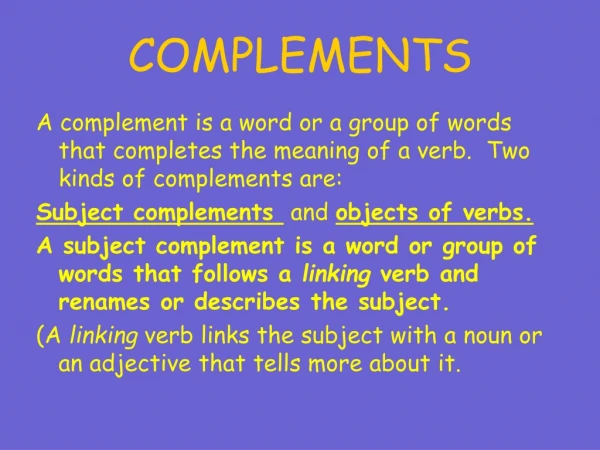
A Subject Complement is a noun, pronoun or adjective that follows a linking verb. It describes or explains the simple subject. • Ex: Mark Twain’s real namewasSamuel Clemens. • The surfacefeltsticky. Subject Complements
A Predicate Nominative is one kind of subject complement. It is a noun or pronoun in the predicate that explains or identifies the subject of the sentence. • Angela will be our soloist. • The astronaut is she. • A whale is a mammal. Subject Complement
A Predicate Adjective is another kind of subject complement. It is an adjective in the predicate that modifies the subject of the sentence. • Ex: That soil looks dry. [dry soil] • The soup is too hot. • She looks capable. • The prizewinners are Jennifer and Brad. • The corn tastes sweet and buttery. Subject Complement
Identify each complement; tell whether it is nominative or predicate adjective: • Those are dangerous. • Sara Brown became famous and classy. • It could be a creature. • Are you sure? • The test seemed impossible. • That recording sounds like Keisha. Practice-Subject Complements