Download
1 / 14
140 likes | 279 Views
This paper explores the concepts of phase velocity, absorption, and reflection in the context of polarized light. It delves into total internal reflection phenomena with particular emphasis on TE and TM polarizations, highlighting the significance of phase shifts resulting from dielectric reflections. The study covers the properties of the Fresnel rhomb and Jones matrices in relation to optical elements like phase retarders and polarizers. Additionally, it investigates optical activity and its relationship to circular birefringence, providing insights into the manipulation of polarization through various optical effects.

E N D
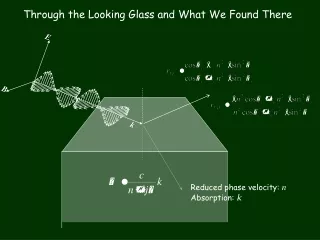
Through the Looking Glass and What We Found There E B k Reduced phase velocity: nAbsorption: k
TE TM TM TE internal reflection:n = 0.667 external reflection:n = 1.5
variable phase TE TE TM TM internal reflection:n = 0.667 external reflection:n = 1.5
write r in this form: Why? Because: phase shift = 2a
TM TE TM-TE Phase shift upon total internal reflection: TM TE Tunable phase lag based only on dielectric reflections!
The Fresnel Rhomb: linear glass circular
Phase Retarder “birefringence” A dependence of the index of refraction on polarization (anisotropy in n). Jones:
Jones matrix: Phase Retarder circular or elliptical SA linear Phase shift between H and V.
1/8 WP QWP FA polarizer SA TA Phase Retarder
Jones Matrix: Rotator rotate by b linear “optical activity” Rotation of linearly polarized light as it travels through a material.
“optical activity” r = Specific rotation: 10’s – 100’s degree/mm (depends on wavelength) RCP + LCP = linear nL> nR Optical activity can be thought of as the result of circular birefringence!
Manipulating Polarization: Dichroism Birefringence Linear Circular